training
has a
number.
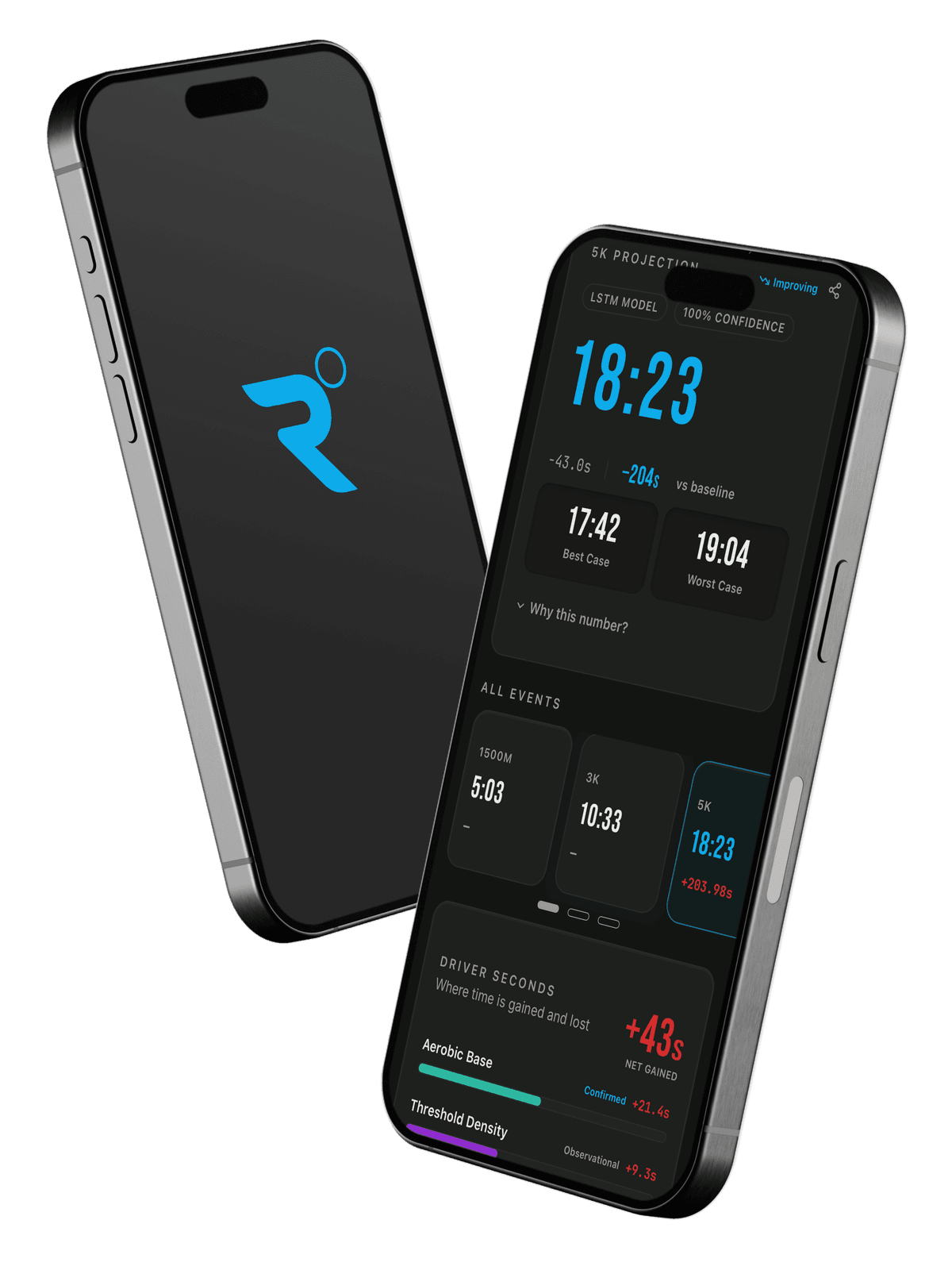
PIRX models what your training is structurally capable of producing — in race-specific, second-accurate projections. Not a recovery score. Not a VO2 estimate. The mathematics of your actual potential.


your results.
Seven things PIRX does that no other app does. This is what makes it different.
Projection
PIRX looks at your training and tells you how fast you can race right now. It uses your real history — not a guess.
Drivers
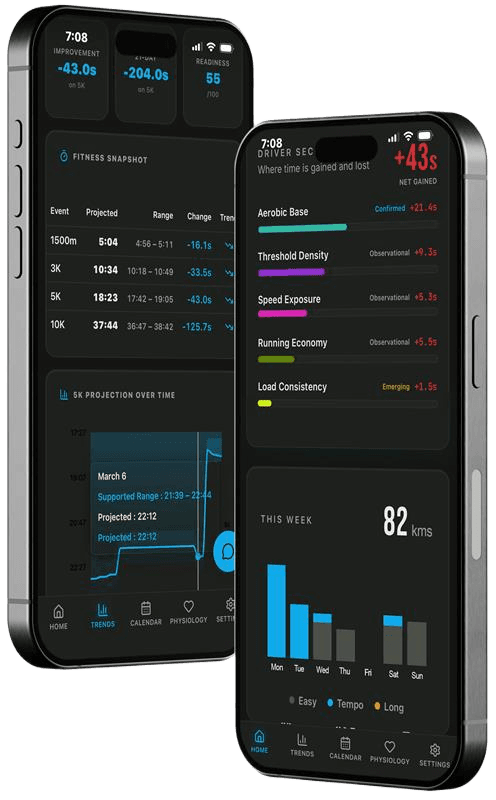
Base: +21s. Threshold: +9s. Speed: +5s. PIRX shows you how many seconds each part of your training is worth. No other app does this.
Confidence
PIRX gives you a score out of 100 for your race distance. 97/100 means you're ready. Built for your race, not a generic number.
Agnostic
Garmin. COROS. Polar. PIRX is an intelligence layer above the hardware. No ecosystem lock-in. Works with what you already own.
Tracking
Taking supplements or trying new performance/recovery tools? PIRX tracks what you use and shows you if it's making a real difference to your times.
Integration
Log your blood tests and lactate scores in one place. PIRX links that data to your training so you can see what it actually means.
Identity
Are you threshold-dominant? A speed-endurance specialist? PIRX figures out how you're built and shows you where your real gains are coming from.
has a source.
Aerobic base gave you 21 seconds. Threshold density gave you 9. Speed exposure gave you 5. No other platform on earth breaks your projection down this way. This isn't just data. This is accountability.
Just Math.
Real numbers.
Join the founders.
Join the waitlist to get exclusive Founding Member pricing. Your personal sign-up link will be emailed Spring 2026.
- ✓14-day free trial
- ✓All 12 intelligence modules
- ✓Full fitness snapshot + projections
- ✓Performance drivers in seconds
- ✓Event readiness scoring (1500m–10K)
- ✓Physiology & intervention log
- ✓All wearable integrations
- ✓Rate locked for life
- ✓Founding member recognition
No credit card required
- ✓14-day free trial
- ✓All 12 intelligence modules
- ✓Full fitness snapshot + projections
- ✓Performance drivers in seconds
- ✓Event readiness scoring (1500m–10K)
- ✓Physiology & intervention log
- ✓All wearable integrations
questions?
Everything you need to know about how PIRX works, what it measures, and why you can trust it.
PIRX is a running performance intelligence system that connects to your watch, reads your training data, and produces a Projected Time — its best estimate of how fast you could finish a race right now. It also tells you why the number is what it is by breaking your training down into five measurable drivers.
PIRX supports Garmin, Strava, Apple Health, Google Fit, Fitbit, Polar, COROS, Suunto, WHOOP, and Oura. If you use more than one device, PIRX can pull data from all of them. Once connected, your workouts flow in automatically within minutes of finishing a run.
Only you can see your data. PIRX uses secure authentication, encrypted wearable connections, and row-level security policies in the database — meaning even at the storage layer, each user can only access their own rows. Chat conversations are also private and tied to your account.
Aerobic Base (weekly volume), Threshold Density (time at hard sustained effort), Speed Exposure (fast intervals and strides), Running Economy (efficiency improvement over time), and Load Consistency (week-to-week training stability). Each driver scores 0–100 and together they paint a complete picture of your current fitness.
PIRX scores each driver, applies a weight reflecting its impact on race performance, and combines them into a single improvement number relative to your Baseline. The result is your Projected Time. Every prediction includes a Supported Range — a high and low estimate — because no prediction is perfect.
PIRX uses five thinking tools: a Rules Engine (safe math from day one), a Personal Prediction Model (Gradient Boosting trained on your data), a Memory Model (LSTM that reads your training in sequence), a Similarity Finder (Dynamic Time Warping to match past blocks), and Sorters (classifiers for readiness and training style). It picks the right tool for each question.
Yes. As your data grows, PIRX trains a personal model on your unique patterns. Before promoting any model, it runs an accuracy test — only models that outperform the generic rules go live. If a personal model ever produces a strange result, PIRX instantly falls back to the safe Rules Engine. You never see a bad prediction from a glitchy model.
PIRX uses dampening to smooth predictions. One workout is a noisy signal — real fitness changes happen over weeks of consistent training. Dampening ensures your Projected Time reflects genuine trends, not daily noise. Your projection also only updates on screen when the change is at least two seconds.
PIRX breaks every update down by driver: "Aerobic Base improved your time by 12 seconds. Load Consistency cost you 5 seconds." The individual contributions always add up to the total change — nothing is hidden. This turns a mysterious number into actionable insight about where to focus.
Yes. From your 5K projection, PIRX estimates 10K, half marathon, marathon, and shorter track distances using a proven scaling formula. It personalizes the estimate based on your training volume — runners logging more miles hold pace better over longer distances. With enough race data, PIRX fits a personal scaling exponent just for you.
PIRX gives you a Readiness score from 0 to 100 based on five components: training load balance, rest and freshness, recent quality work, body signals (sleep, HRV, resting HR), and week-to-week consistency. Labels range from Peak (primed to perform) to Very Low (rest recommended).
PIRX watches for training load spikes, crash-after-hard-block patterns, and unexplained performance drops — all of which historically precede injuries. It rates your risk as Low, Moderate, or High. PIRX is not a doctor, but it is an early warning system that spots risky patterns before they become real problems.
Yes. PIRX has a built-in chat where you can ask questions in plain English. The AI agent has 16 specialized tools to look up your real data — projections, drivers, readiness, injury risk, training analysis, and more. It only gives advice when it can cite your actual numbers to support it.
After 10 days without activity, PIRX widens the Supported Range and lowers confidence. After 21 days, it marks your status as Declining. Your history and personal model are never erased — the moment you resume running, new data flows in and the prediction sharpens back to normal precision within a few workouts.
PIRX will never make up advice, push you toward danger, fake confidence, share your data, or guess when data is missing. If it doesn't have enough information, it says so. If your injury risk is high, it flags it. If it's uncertain, the range widens. Safety and honesty are non-negotiable.
the list.
Join the waitlist for early access. We'll review every application and onboard runners in waves.