Why Your Smartwatch Thinks You're Faster (or Slower) Than You Actually Are
On this page
Are smartwatch race predictions accurate? Often, no. Your watch starts with a guessed VO2 max score. It turns that one score into a race time. But the guess can be off. And one score cannot tell your stamina from your speed. So your watch may say you are faster, or slower, than you really are. The better fix is to learn your own profile, not lean on a generic score.
| What the watch sees | What your race time needs |
|---|---|
| A guessed VO2 max from heart rate and pace | Your true oxygen ceiling, measured in a lab |
| One score used for every distance | A split of stamina and speed by distance |
| No read on your steady hard pace | Lactate threshold: the hard pace you can hold |
| No read on your stride cost | Running economy: how little fuel you burn at a pace |
Get your own projection in seconds — free, no signup, no wearable.
Race Time PredictorAre smartwatch race predictions accurate?
Often they are not, and the error grows as you get fitter. Your watch never measures the air you breathe. It guesses your VO2 max from your heart rate and your pace. Then it maps that guess to a finish time with a fixed rule. One study put a Garmin watch up against a lab test. In mid level runners the gap was small, about 3 to 4 percent. In well trained runners the gap rose near 10 percent, and the watch read low (Engel et al., 2025). So the fitter you get, the more the number can drift. That is the opposite of what a racer wants. The people who care most about a goal time get the shakiest guess. That is a real problem on race day.
Why is my Garmin race predictor wrong?
Your Garmin race predictor leans on that same VO2 max guess, so its faults flow into your race time. The guess lives inside a hidden formula that the maker does not share (Engel et al., 2025). You cannot see what it weighs, or why. The watch also cannot feel race day. It does not know the heat, the hills, or how deep your long runs went. A broader test of wrist trackers found most missed the lab mark by more than 10 percent (Passler et al., 2019). The best device still had a wide spread, near 17 points of VO2 max from high to low. For Garmin race predictor accuracy, that is a lot of room to be wrong. A rough guess in means a rough time out.
What does a wrist VO2 max score really measure?
It measures a guess, not your oxygen use. A lab uses a mask to read the air you breathe in and out. Your watch has no mask. It infers a number from your pace and your pulse, then calls it VO2 max (Passler et al., 2019). Even at its best, that guess is just one number. And one number flattens a runner into a single trait. It says nothing about your steady hard pace. It says nothing about how smooth your stride is. Both of those shape your race time as much as raw fitness does. So the watch starts a full step behind the real answer. It is a smart tool. But it is still a guess.
Why does wrist heart rate make the guess shaky?
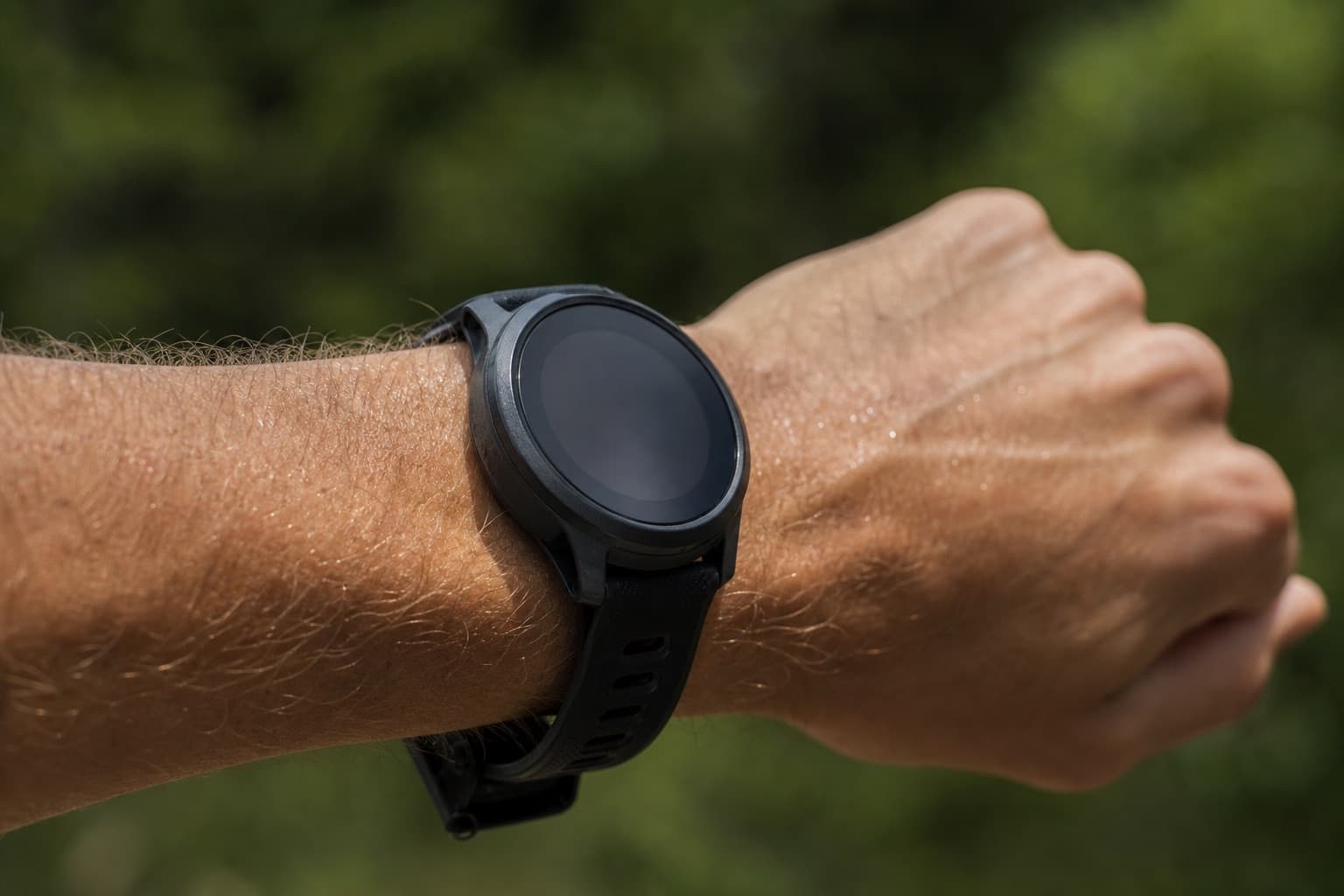
Because your watch reads your pulse from your skin, and that read can slip. The watch shines a small light on your wrist. It counts your beats from the blood under the light. That works well when you sit still. But it can drift when you run hard, pump your arms, or sweat. One study tested 50 runners on a treadmill. A chest strap nearly matched a medical heart trace, at a score of 0.98. The wrist watches scored lower, near 0.89 (Pasadyn et al., 2019). Your VO2 max guess sits on top of that pulse. A shaky input makes a shaky result. So the chain can bend at the very first link. The faster you run, the more the wrist read can slip. That is the exact moment you most want it to be right.
Why does VO2 max get endurance and speed wrong?
Because no single number drives every distance the same way. Race scientists are clear on this point. What predicts a fast mile is not what predicts a strong marathon (Denadai & Greco, 2022). For short races, your top speed matters most. For long races, your steady hard pace matters most. That steady hard pace has a name. It is your lactate threshold, the fastest pace you can hold before you fade. A watch that leans on one VO2 max score cannot split these traits. So it tends to flatter a fast runner over long miles. And it can sell a steady runner short over short ones. Picture two friends, Mia and Jon. Mia has great top speed but a weak steady pace. Jon is the other way around. The watch sees one high score for Mia. It calls for a fast marathon. But Mia fades hard past mile 18. Jon holds his steady pace and beats the watch's call for him. One number fooled it both ways. This is why VO2 max race prediction goes wrong for so many people. The watch saw one trait and missed the rest.
Can two runners with the same VO2 max run different times?
Yes, and the gap can be huge. Two runners can share the very same VO2 max and still finish minutes apart. Say both test at 60. One runs a 40 minute 10K. The other runs 44. Same score, four minutes apart. The reason is running economy, or how little fuel you burn at a set pace. The runner who burns less can hold the pace longer. Same engine, different fuel use. The road shows the gap.
- 30%
- how much running economy can differ between runners with the same VO2 max (Barnes & Kilding, 2015)
One research review found that running economy can vary by as much as 30 percent among trained runners with the same VO2 max (Barnes & Kilding, 2015). A study of top Ethiopian runners went further. It found that great economy can make up for a lower VO2 max at the elite level (Gebremariam et al., 2025). Your watch never sees your economy. So it cannot see the very thing that often decides the race.
Does my watch know how race day will slow you down?
No. Your watch cannot see the weather, and weather can move your finish time a lot. Heat is the clearest case. Researchers looked at many years of marathon results next to the weather on race day. As the air warmed, runners slowed down. Even the race winners slowed in the heat (Ely et al., 2008). Slower runners faded the most in the late miles. Now think about how that breaks a watch guess. Your watch built its number on a cool training run. It does not know the start line will be warm. It does not know the hills on the course. It does not know you slept poorly or went out too fast. So a time that looked great in spring can miss in a hot summer race. The day itself changes the math, and your wrist never sees it coming.
Is your smartwatch VO2 max useless then?
No, it still has a real use. A wrist VO2 max is fine for spotting trends over time. If the number climbs week to week, your base is likely growing. That is good to know. The same study that flagged big errors in fit runners found smaller errors in mid level ones, near 3 to 4 percent (Engel et al., 2025). So use the trend, not the exact time. Watch the slope, not the single point. Just do not bet a race plan on it. The day you set a goal, you want a number built on your real runs, not one guess.
How is PIRX different from a watch guess?
PIRX skips the VO2 max guess and learns you instead. It is a proprietary machine-learning prediction engine, not one fixed formula. It reads your real runs and breaks your fitness into 5 drivers. They are Aerobic Base, Threshold Density, Speed Exposure, Load Consistency, and Running Economy. Together these add up to your seconds, gained or lost. You get a Projected Time, plus a Supported Range, the band your time should land in. It updates after each run you sync. A new time shows only when the change is real, at least 2 seconds. Want the full picture first? Read the complete guide to predicting your race time, check if your goal time is realistic, or see how PIRX stacks up against Strava and Garmin.
- 98%
- validated prediction accuracy (PIRX users)
Get your real number
Stop guessing what your training is worth. A generic watch score treats every runner the same. PIRX does not. Connect your Garmin, COROS, or Strava in under a minute. See your 5 drivers. See where your seconds come from. Then get a race time built on your own data, not a guess. It is free, and you do not need a new watch. Your goal deserves better than a number your wrist made up. Run the free predictor now. Your real time is seconds away.
Get your own projection in seconds — free, no signup, no wearable.
Race Time PredictorSources
- Engel et al., 2025, European Journal of Applied Physiology. Validity of VO2max estimates from the Forerunner 245 smartwatch (Watch under-reads VO2 max; error rises to about 10 percent in well trained runners.)
- Passler et al., 2019, Int. Journal of Environmental Research and Public Health. Validity of wrist-worn activity trackers for estimating VO2max (Most wrist trackers miss lab VO2 max by more than 10 percent.)
- Denadai & Greco, 2022, Current Research in Physiology. Could running performance be predicted by the same aerobic parameters? (Different distances are best predicted by different traits, not one VO2 max.)
- Barnes & Kilding, 2015, Sports Medicine - Open. Running economy: measurement, norms, and determining factors (Running economy can vary up to 30 percent among runners with the same VO2 max.)
- Gebremariam et al., 2025, BMC Research Notes. Running economy and VO2max in elite Ethiopian distance runners (Strong economy can offset a lower VO2 max at the elite level.)
- Pasadyn et al., 2019, Cardiovascular Diagnosis and Therapy. Accuracy of commercially available heart rate monitors in athletes (Wrist heart rate agreed with a medical trace less well than a chest strap, near 0.89 vs 0.98.)
- Ely et al., 2008, Medicine and Science in Sports and Exercise. Effect of ambient temperature on marathon pacing (Warmer race-day weather slows finish times, with slower runners hit hardest.)
Already know your number? Start your 14-day free trial