How to Improve Running Economy (Proven Methods)

On this page
Heavy strength training is the best proven way to improve running economy. It can cut your oxygen cost by 2 to 8 percent in weeks. Jump training and form drills add more on top. Economy can vary by 30 percent between runners with the same size engine. So it is worth training on purpose, not leaving to chance.
The table below shows the main ways to improve economy. It lists the proof behind each one.
| Method | Evidence | Typical effect |
|---|---|---|
| Heavy strength training | Review of 24 studies, 469 runners | 2 to 8 percent better economy in most studies |
| Plyometric jump training | Head-to-head test vs. heavy lifting | Smaller gain than lifting, best after 10+ weeks |
| Running form drills | Review of trained runners | Small gains from arm swing and low bounce |
| More easy training miles | Long-term training studies | Slow, steady gains over months, not weeks |
Get your own projection in seconds — free, no signup, no wearable.
Race Time PredictorWhat is running economy?
Running economy is your fuel cost. It is how much energy you burn to hold a pace. Picture two runners. Both have the same size engine. Doctors call this VO2 max. It is the most oxygen your body can use in one minute.
But engine size is not the whole story. Both runners run the same pace. One uses less oxygen to do it. That runner has better economy. Less oxygen used means more fuel saved. It often means a faster finish too.
The gap can be huge. Trained runners can vary by 30 percent in economy. This is true even with the same VO2 max (Barnes & Kilding, 2015). Same size engine. Very different race results. Economy is the reason why.
Economy matters most in longer races. A 5K is short and fast. Raw power can carry you through it. A marathon is long. Fuel cost adds up over 26.2 miles of steady effort. Small savings each mile turn into minutes saved by the finish line. This is why marathoners often chase economy work harder than sprinters do.
Why does economy beat VO2 max?
Economy often predicts race day better than VO2 max. VO2 max sets your ceiling. It shows your engine size. But a big engine that burns fuel poorly will not beat a small, clean one.
Two runners can share a VO2 max score. Yet they finish a marathon minutes apart. The runner with better economy spends less fuel each mile. That saved fuel shows up late. It shows up right when other runners fade.
Here is a simple way to picture it. Say two runners both use 50 milliliters of oxygen per kilogram each minute at their max. That is the same VO2 max. But at marathon pace, one uses 5 percent less oxygen than the other. Over 26.2 miles, that gap adds up. The more efficient runner crosses the line well ahead, even with the exact same size engine.
VO2 max is also hard to raise once you are trained. Hard intervals lift it a little. The ceiling barely moves after that. Economy responds to more kinds of training. That makes it a better place to find real gains in speed (Barnes & Kilding, 2015).
- 30%
- the variation in running economy among trained runners with similar VO2 max (Barnes & Kilding, 2015)

Does strength training improve economy?
Yes. Strength training has the best proof behind it. One review checked 24 studies. It covered 469 distance runners. Economy improved in most trials. Gains often hit 2 to 8 percent after a strength program (Blagrove et al., 2018).
Heavy weights beat light, high-rep sets for this goal. One study compared heavy lifting to jump training. Heavy lifting won. The gain was bigger and more reliable. This held even more when loads sat near a runner's true max (Eihara et al., 2022).
The gains are not just bigger muscles. Strength work trains your nerves to fire muscles faster. It also stiffens your tendons. Stiff tendons store more energy per step. Both changes cut your fuel cost.
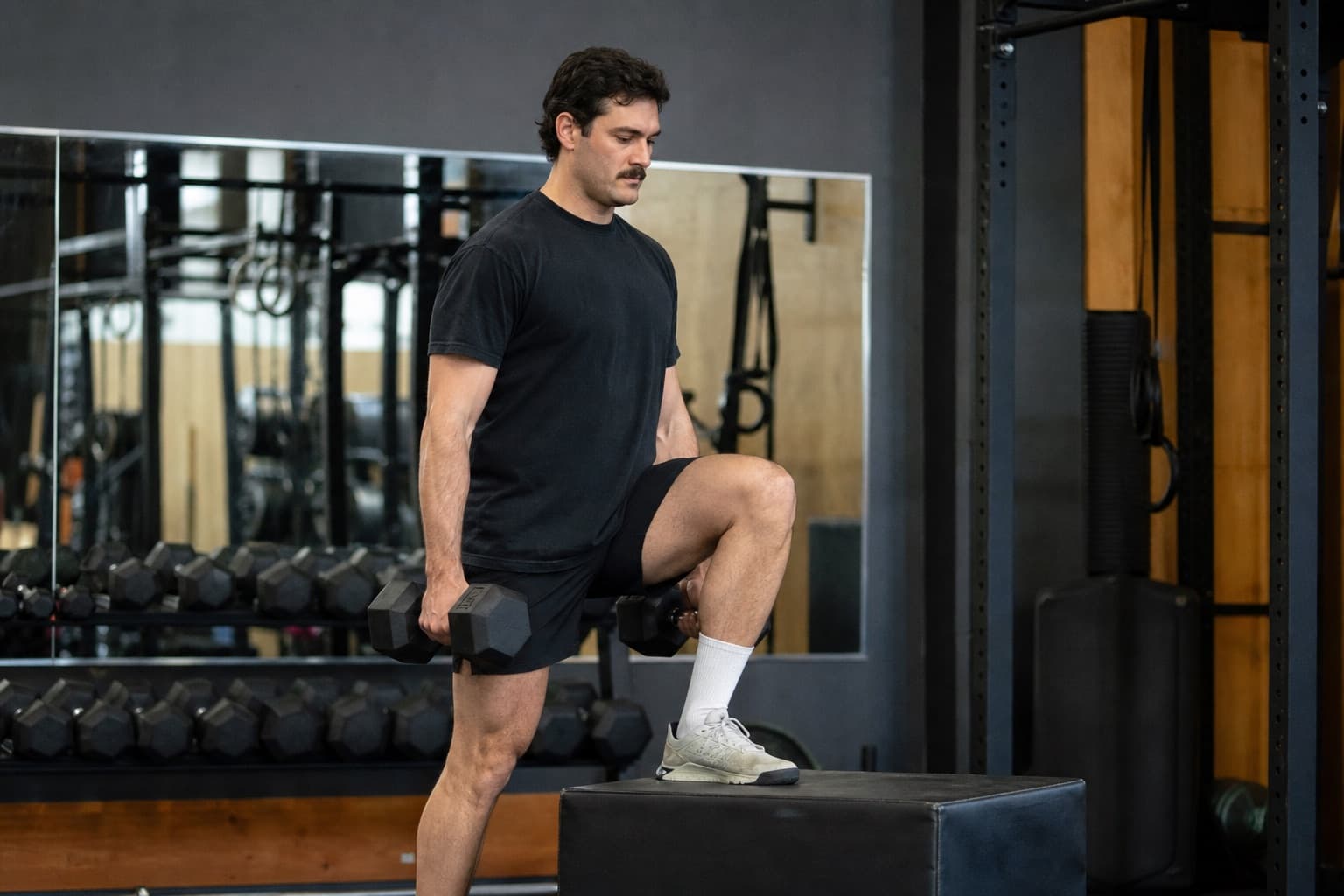
A simple starting plan looks like this. Pick two heavy lower-body lifts, like a squat and a deadlift. Add one single-leg move, like a step-up. Train this twice a week. Keep reps low, around 4 to 6 per set. Rest fully between sets. For the exact moves and schedule, see our guide to strength training for runners.
Do jump drills like plyometrics help?
Yes, but less than heavy lifting alone. Plyometric training means fast, bouncy jumps. Think bounds and hops. It builds leg power fast. It trains the same tendon stiffness as heavy lifting. It just uses a different kind of load.
In direct tests, jump training helped economy less than heavy lifting did (Eihara et al., 2022). But the gains grew with time. Programs of 10 weeks or more worked far better than short ones. Many runners do both. Heavy lifts give the big gain. Jumps add extra spring on top.
A simple jump session might include pogo hops, box jumps, and bounding strides. Two short sessions a week is enough for most runners. Keep the volume low at first. Jump training loads your tendons hard, even in small doses. Add it slowly and give your legs a day of rest after each session.
Can form drills improve economy?
Yes, in smaller but real ways. Some parts of your form link to better economy. Runners who swing their arms freely tend to run cleaner than runners with stiff arms. Less bounce with each stride also links to better economy (Moore, 2016).
These are not huge, single-fix wins. But small form cues can add up. Drills help you practice them until they feel natural. Simple drills like high knees, A-skips, and short strides train quick, light steps. They give your nervous system practice at fast, clean movement patterns. For the drills worth doing, see our guide to running form drills. Cadence plays a part too. Small step-rate shifts change joint load more than they change economy. Our guide to running cadence covers that split.
Does just running more help economy?
Yes, but slowly. Gains from mileage alone take months, not weeks. Years of steady running teach your body to waste less motion. This is why veteran runners often look smooth, even at a hard pace.
The gain is real. It is just slow. It builds over full seasons of training, not single weeks. If you want faster progress, strength work and jumps give you a quicker path than mileage alone.
Think of mileage as the slow, steady base. Strength and jumps are the fast lane on top of it. Runners who use both tend to see the biggest gains. Skipping strength work does not stop your economy from improving. It just makes the climb much slower than it needs to be.
Most studies see clear economy gains within 6 to 10 weeks of steady strength or jump work. That is a short window compared to the months it takes for mileage alone to pay off. If your next race is close, this is where to spend your training time. If your race is still far off, build both together from the very start.
How does PIRX score your economy?
PIRX turns your economy into one of five drivers behind your Projected Time. It is called Running Economy. PIRX scores it from 0 to 100. The score comes from your real training data. It is not a lab test. It is not a rough guess from your wrist.
A wrist-based VO2 max guess cannot see any of this. It gives one number and stops. It cannot say if lifting, jumps, or drills would move your race time. It has no idea by how much.
Two runners could wear the same watch and get the same VO2 max reading. One does two strength sessions a week. The other does none. The watch treats them the same. PIRX does not. It sees the training behind the number, not just the number itself.
PIRX is a proprietary machine-learning prediction engine. It learns your own training patterns. It shows exactly where your seconds come from. That means all five drivers: Aerobic Base, Threshold Density, Speed Exposure, Load Consistency, and Running Economy. Sports scientists have long said economy explains results that VO2 max alone cannot. PIRX is built on that same idea. Seconds first. Guesses never.
- 98%
- validated prediction accuracy (PIRX users)
Stop guessing what your training is worth
Stop trusting a lab VO2 max score to predict your race day. Don't settle for generic watch algorithms that treat every runner the same. Connect your Garmin, COROS, or Strava to PIRX in under 30 seconds. See your Running Economy score next to your other four drivers. Watch your Projected Time move as you train it.
Get your own projection in seconds — free, no signup, no wearable.
Race Time PredictorSources
- Barnes, K.R. & Kilding, A.E. (2015). Running economy: measurement, norms, and determining factors. Sports Medicine - Open. (Running economy can vary by up to 30 percent among runners with similar VO2 max, and it predicts performance.)
- Blagrove, R.C., Howatson, G. & Hayes, P.R. (2018). Effects of strength training on the physiological determinants of middle- and long-distance running performance. Sports Medicine. (24 studies, 469 runners; running economy improved 2 to 8 percent in most trials after strength training.)
- Eihara, Y. et al. (2022). Heavy resistance training versus plyometric training for improving running economy and running time trial performance. Sports Medicine - Open. (Heavy resistance training produced larger gains in running economy than plyometric training.)
- Moore, I.S. (2016). Is there an economical running technique? A review of modifiable biomechanical factors affecting running economy. Sports Medicine. (Arm swing and lower vertical bounce are linked to better running economy.)
Already know your number? Start your 14-day free trial