Driver Strip
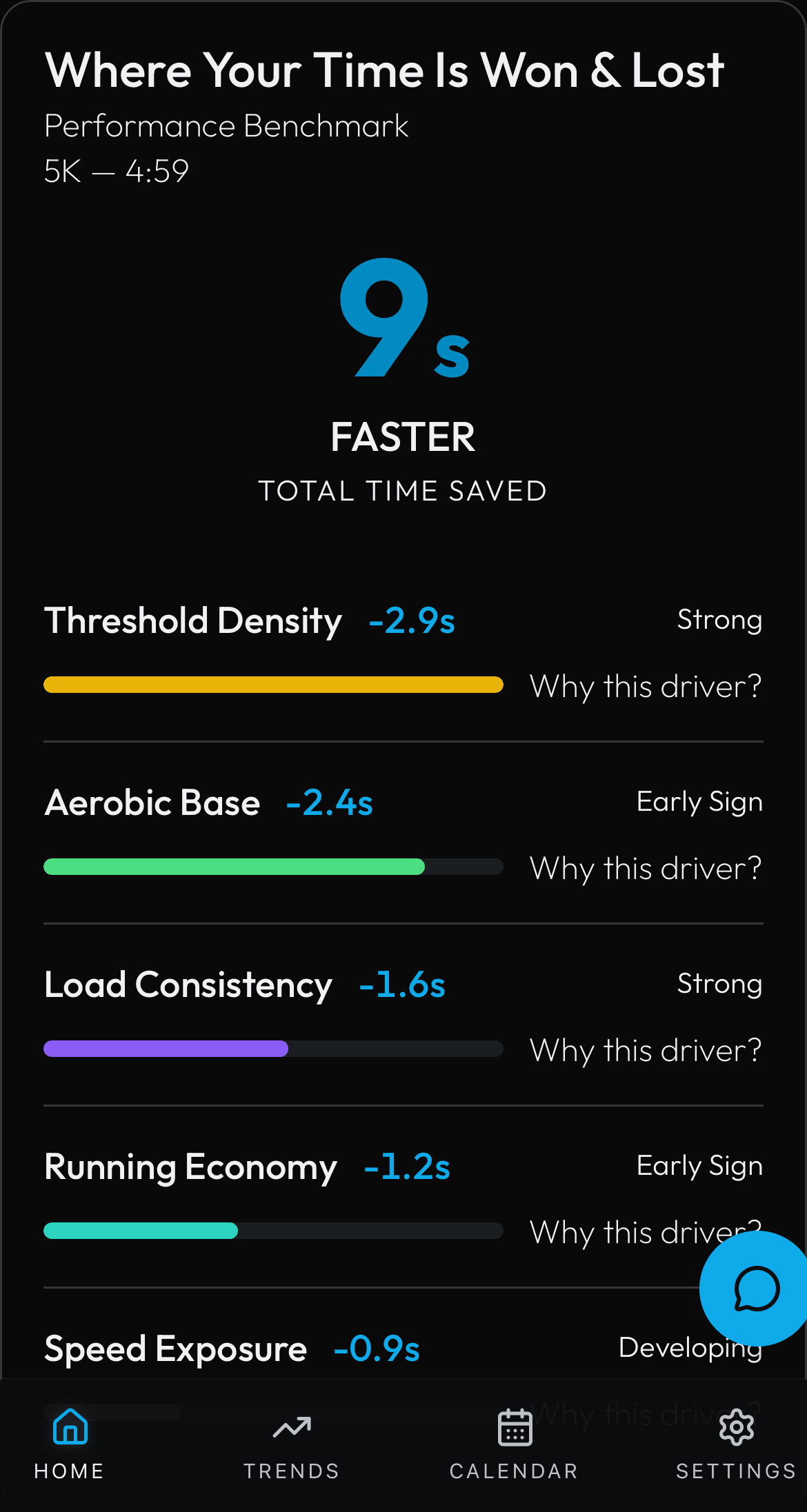
Source: components/home/driver-strip.tsx
What You See
A card titled 'Driver Seconds' with a large net total in the top right corner (like '+18s'). Below are five rows, one for each performance driver: Aerobic Base, Threshold Density, Speed Exposure, Running Economy, and Load Consistency. Each row has the driver name, a colored bar showing its impact, a number in seconds (positive means helping, negative means hurting), and a trend label (Confirmed, Observational, or Emerging).
How the Numbers Work
Each driver is a category of training that affects your race time. The contribution in seconds tells you how much time that driver is saving (positive) or costing (negative) compared to your baseline. The bar width is proportional to the size of the contribution. The trend label shows how confident PIRX is: 'Confirmed' means high confidence, 'Emerging' means the signal is growing, and 'Observational' means PIRX is still gathering data.
Step by Step
Each driver is scored from specific training features. Aerobic Base uses rolling distances (7, 21, 42 days) and Zone 1-2 percentages. Threshold Density uses threshold minutes per week, Zone 4 percentage, and matched-HR-band pace. Speed Exposure uses speed minutes per week and Zone 5 percentage. Running Economy uses heart-rate drift, late-session pace decay, and matched-HR-band pace. Load Consistency uses weekly load standard deviation, block variance, session density stability, and ACWR. Each feature value is divided by a reference baseline, multiplied by 50, and clipped to 0-100 (inverse features like drift use 2 minus the ratio before multiplying). The driver score is the average of its feature scores. Contribution seconds = (driver score times driver weight) divided by the sum of all (score times weight), times the total improvement. The five contributions must sum exactly to the total -- the last driver absorbs any rounding remainder. The trend label is set by the score: above 60 is Confirmed (improving), below 40 is Observational (declining), between is Emerging.