IT Band Syndrome: Why It Flares and How to Come Back

On this page
IT band syndrome is sharp pain on the outside of your knee, and it is one of the most common running injuries. It is not the same as runner's knee, which sits around the kneecap. This pain sits on the outer edge of the knee. It often shows up at the same point in a run and gets worse downhill. Most cases trace back to one thing: load that grew too fast, often paired with weak hips. The fix is smarter load and stronger glutes, not rest alone.
| ITBS sign | What is driving it | What helps |
|---|---|---|
| Sharp pain on the outside of the knee that starts at the same point each run | Tissue near the outer knee is squeezed as the knee bends and lands | Stop the run when the pain starts; cut your miles, then rebuild slowly |
| Pain that flares going downhill or down stairs | The knee holds a shallow bend where the band presses hardest | Stick to flat, soft ground while you heal; add hills back last |
| Pain after a fast jump in weekly miles | A load spike that outran your tissue (low Load Consistency) | Grow weekly load in small steps; keep your weeks even |
| The hip drops or the knee rolls in as you run | Weak glutes let the hip and knee fall inward each step | Strengthen your hip and glute muscles two to three days a week |
| Outer-knee pain that will not settle after weeks | Tissue still irritated, or a different knee problem | See a healthcare professional for a real diagnosis |
Get your own projection in seconds — free, no signup, no wearable.
Race Time PredictorWhat is IT band syndrome?
IT band syndrome is pain on the outside of the knee from an irritated IT band. The IT band is a thick strip of tissue. It runs down the outside of your thigh. It goes from your hip to just below your knee. Doctors call this injury ITBS for short. It is a top cause of outer-knee pain in runners.
How common is it? In one set of running injuries, ITBS was the third most common kind (Beals & Flanigan, 2015). The same review found it can make up as much as 22% of all lower-limb running injuries.
- 22%
- of running lower-limb injuries can be IT band syndrome (Beals & Flanigan, 2015)
Here is the key difference from runner's knee. Runner's knee is pain around or behind the kneecap. That pain sits at the front of the joint. ITBS sits on the outer side. If your pain is at the front, read our guide to stopping kneecap pain before it costs you weeks instead. The two get mixed up a lot. But they are not the same. They need different fixes.
What does IT band syndrome feel like?
ITBS feels like a sharp or burning pain on the outside of the knee. The pain often starts about an inch above the joint, on the outer edge (Beals & Flanigan, 2015). Some runners feel a click or a pop there too.
The pattern is the giveaway. The pain tends to come at a set point in a run. You may feel fine for the first mile or two. Then the outer knee starts to bite. It gets worse the longer you go. It eases once you stop.
Downhill running makes it worse. So do stairs. Many runners have no pain on flat ground. But they wince on a hill. That clear pattern is useful. It points right at the IT band, not the kneecap.

What causes IT band syndrome?
The most common cause of ITBS is too much running load, too fast. Your tissue can take a lot of work. But only up to a point. Push past that point too soon, and the tissue gets irritated. Pain follows.
Sudden change is the real trigger. Big jumps in weekly miles, a lot of downhill running, and hard speed blocks all raise the risk (Beals & Flanigan, 2015). Your heart and lungs adapt in days. The IT band takes weeks. The gap between the two is where the injury hides.
Weak hips add to the risk. When your hip muscles are weak, your hip drops and your knee rolls in on each step. That motion loads the IT band more. One study found that runners with ITBS had "weaker hip abduction strength in the affected leg" than healthy runners (Fredericson et al., 2000). Strong glutes keep the hip level and the knee straight.
One honest note. The science here is still mixed. A review found the proof for any one risk factor "remains limited and inconsistent" (Aderem & Louw, 2015). So no one factor is the whole story. But the trend across studies points to load and hip strength. Those are the two levers you can pull.
Why does IT band syndrome hurt more downhill?
It hurts more downhill because of the angle of your knee when your foot lands. Older thinking said the band rubbed over the bone like a rope. Newer work pushed back on that. One study found the band does not slide much at all. Instead, it presses on a layer of fat and tissue against the bone (Fairclough et al., 2006).
That pressing is worst at a shallow knee bend, around 20 to 30 degrees (Aderem & Louw, 2015). Your knee passes through that range each time your foot lands. Downhill running holds the knee near that angle longer. It also adds more force on each step. So the tissue gets squeezed more often and harder. That is why a hill can light up a knee that felt fine on the flat.
This points to a simple early fix. While you heal, stay off downhills. Run flat, soft routes. Add hills back only once the pain is gone.
How do load spikes trigger IT band syndrome?
Load spikes trigger ITBS by stressing the tissue faster than it can adapt. This is where one of the five PIRX drivers comes in: Load Consistency. Load Consistency tracks how steady your training is from week to week. A high score means small, smooth steps. A low score means big jumps and big drops.
A sharp spike drags that score down. It also raises injury risk. The fix is to keep your weeks even. Add miles in small steps. Do not chase a missed week with a sudden surge. If you are not sure how much volume is safe to build, start with how many miles per week is right for you.
Rest weeks help too. Planned easy weeks let slow tissue catch up to your fast-adapting lungs. We cover how to time them in why a down week makes you faster. And for the bigger picture on how one overloaded driver can stall a whole training block, see how overloading one driver blurs your progress.
How do you fix IT band syndrome?
The proven fix is smart load plus hip and glute strength work, not full rest. Step one is to cut your running until the pain during a run is mild. Then add load back in small steps as the pain allows. A surgeons' group, the AAOS, sums up the care as "rest, physical therapy, and gradual return to activity" (OrthoInfo / AAOS).
This works well in studies. A review found that basic care, meaning rest, stretching, and changes to how you run, "produced a 44% complete cure rate, with return to sport at 8 weeks" (Beals & Flanigan, 2015). Many cases settle with no surgery at all.
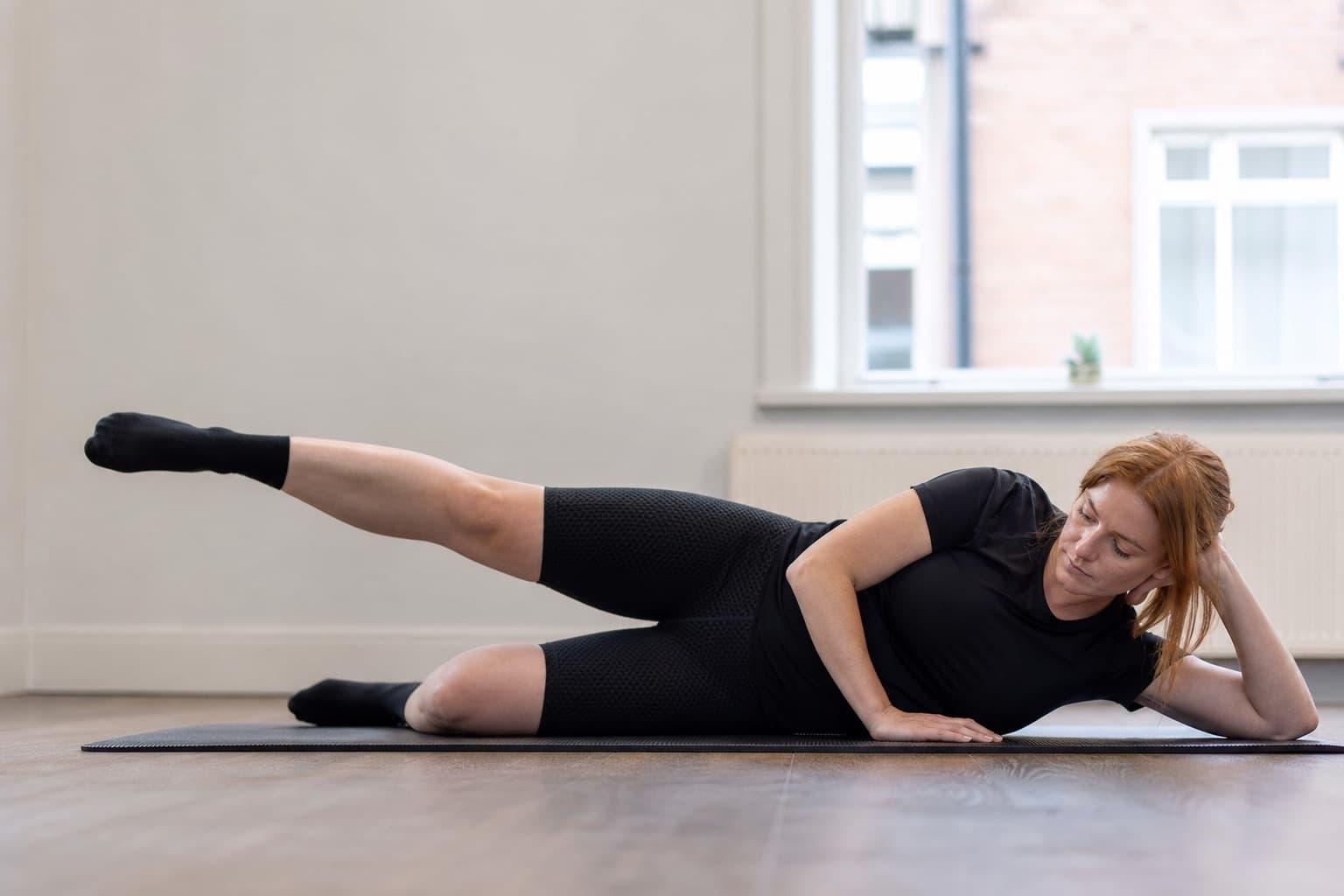
Strength work is the other half. In one clinic program, runners did a six-week plan of hip and glute moves. Twenty-two of the twenty-four runners, or 91.7%, were back to running by the end (Beals & Flanigan, 2015). Side-lying leg lifts, band walks, and single-leg work build the muscles that keep your hip level.
You can also ease the load while you run. Take quicker, shorter steps. Run on flat, soft ground. Skip the downhill routes for now. Small tweaks lower the stress on the outer knee while the tissue heals.
One note of caution. This is general guidance, not medical advice. Pain that lasts more than a couple of weeks needs a doctor. So does sharp pain, or a knee that gives way. See a doctor or physical therapist for a real diagnosis.
How long does IT band syndrome take to heal?
Most runners recover within about 6 weeks of treatment (OrthoInfo / AAOS). That assumes you catch it early and manage the load. The timeline is not fixed, though. It depends on how bad the case is and how long it has been there.
- 6 weeks
- typical return to running with conservative care (OrthoInfo / AAOS)
A mild, fresh case can calm down in a week or two of lighter running. A case you have pushed through for months can take longer. The earlier you back off, the faster you heal. That is the real lesson. The runners who heal fastest stop at the first warning. They do not grind through it.
How does PIRX help you avoid IT band syndrome?
PIRX helps by showing your Load Consistency before a spike turns into pain. PIRX is a proprietary machine-learning prediction engine. It reads your real runs from your watch. It scores five drivers, and Load Consistency is one of them. A falling score is an early sign that your weeks are getting choppy.
A one-size-fits-all calculator cannot do this. It sees a finish time and nothing else. It does not know you just doubled your downhill miles. A wrist VO2 max number cannot see it either. PIRX reads the shape of your training, not just the totals. Two runners with the same weekly miles can get very different scores.
It recalculates after every synced run. A visible change in your Projected Time shows only when the change is at least 2 seconds. So a normal week stays quiet. But a real spike shows up fast, often before your knee does. The Projected Time comes with a Supported Range. That range shows the spread of likely finish times for your fitness.
PIRX is not a medical tool. It cannot find an injury. But it can flag when your load is drifting into risky ground. That is often enough to back off in time. If you already have outer-knee pain, see a doctor first.
- 98%
- validated prediction accuracy (PIRX users)
See your Load Consistency before your knee complains
Stop guessing whether your training is safe. Generic watch apps track miles and pace. PIRX does more. Connect your Garmin, COROS, or Strava in under a minute. See all five driver scores. Watch your Load Consistency week to week. Catch a load spike early, before it costs you weeks of training to a sore IT band. Get a race-time projection built on your own data, not a single fixed formula. Free, no signup needed.
Get your own projection in seconds — free, no signup, no wearable.
Race Time PredictorSources
- Beals, C. & Flanigan, D. (2015). A Review of Treatments for Iliotibial Band Syndrome in the Athletic Population. Journal of Sports Medicine. (ITBS is a common cause of lateral knee pain in runners, up to 22% of lower-limb running injuries. Conservative care produced a 44% complete cure rate at 8 weeks; a six-week hip strength program returned 91.7% of runners to running.)
- Fredericson, M., Cookingham, C.L., Chaudhari, A.M., et al. (2000). Hip Abductor Weakness in Distance Runners with Iliotibial Band Syndrome. Clinical Journal of Sport Medicine. (Runners with ITBS had weaker hip abduction strength in the affected leg than healthy runners.)
- Aderem, J. & Louw, Q.A. (2015). Biomechanical risk factors associated with iliotibial band syndrome in runners: a systematic review. BMC Musculoskeletal Disorders. (Tissue compression peaks near 20 to 30 degrees of knee flexion; evidence for any single risk factor remains limited and inconsistent.)
- Fairclough, J., Hayashi, K., Toumi, H., et al. (2006). The functional anatomy of the iliotibial band during flexion and extension of the knee. Journal of Anatomy. (The band does not slide like a rope; pain comes from compression of fat and tissue against the bone.)
- OrthoInfo / American Academy of Orthopaedic Surgeons. Iliotibial Band (IT Band) Syndrome. (An overuse injury on the outside of the knee; most patients return to running within 6 weeks of conservative treatment.)
Already know your number? Start your 14-day free trial