How Many Gels for a Marathon? Carbs-Per-Hour Guide

On this page
Here is the short answer. Most marathoners need 5 to 10 gels, spaced every 30 to 45 minutes after the first 3 to 4 miles. The right count for you depends on your carbs-per-hour target. That target changes with your pace. Faster runners burn more fuel per hour. So they need more gels than slower runners do.
The table below breaks this down by finish time.
| Finish time | Carbs per hour | Gels for the race | When to start |
|---|---|---|---|
| Under 3:00 | 60-90 g | 8-10 gels | Mile 4, every 20 min |
| 3:00-3:30 | 60-75 g | 7-9 gels | Mile 4, every 25 min |
| 3:30-4:00 | 45-60 g | 6-7 gels | Mile 3, every 30 min |
| 4:00-4:30 | 30-45 g | 5-6 gels | Mile 3, every 35 min |
| 4:30 and up | 30 g | 4-5 gels | Mile 3, every 40 min |
Get your own projection in seconds — free, no signup, no wearable.
Marathon Time PredictorHow many carbs per hour do you need in a marathon?
Most runners need 30 to 90 grams of carbs per hour. The right number depends on how hard you work. Your gut has a speed limit for one type of sugar. Glucose alone caps out near 60 grams an hour (Jeukendrup, 2014). Past that point, your body cannot absorb any more, no matter how much you eat.
Mixing two sugar types gets around this limit. Most gels blend glucose and fructose. These two sugars use different paths into your gut. Together, they let your body absorb up to 90 grams an hour (Jeukendrup, 2014). That is why most race gels list both sugars on the label.
- 90 g
- max carbs per hour supported by research for long, hard efforts
Here is the twist, though. That 90-gram figure is for hard, long efforts. Slower running burns carbs at a slower rate. Your muscles simply do not need as much fuel per hour. Pushing 90 grams into a body that only burns 40 can cause stomach trouble. A 5-hour marathoner does not need the same intake as a 3-hour marathoner (Jeukendrup, 2014).
How many gels does that add up to?
Most gels carry 20 to 30 grams of carbs each. Check the label on your brand. Brands vary more than you might expect. If your target is 60 grams an hour, and your gel has 25 grams, you need a bit more than two gels an hour. Over a 3.5-hour marathon, that lands around 7 to 8 gels total. That matches the table above.
Do not just count gels on their own. Sports drinks count too. Chews and real food at aid stations count too. Add up the carbs from everything you plan to eat. Then adjust your gel count so the total hits your target, not more.
A simple way to check your math: write down every carb source for your race. List the grams for each one. Add them up per hour, not per item. If the hourly total is too high, drop a gel. If it is too low, add one.
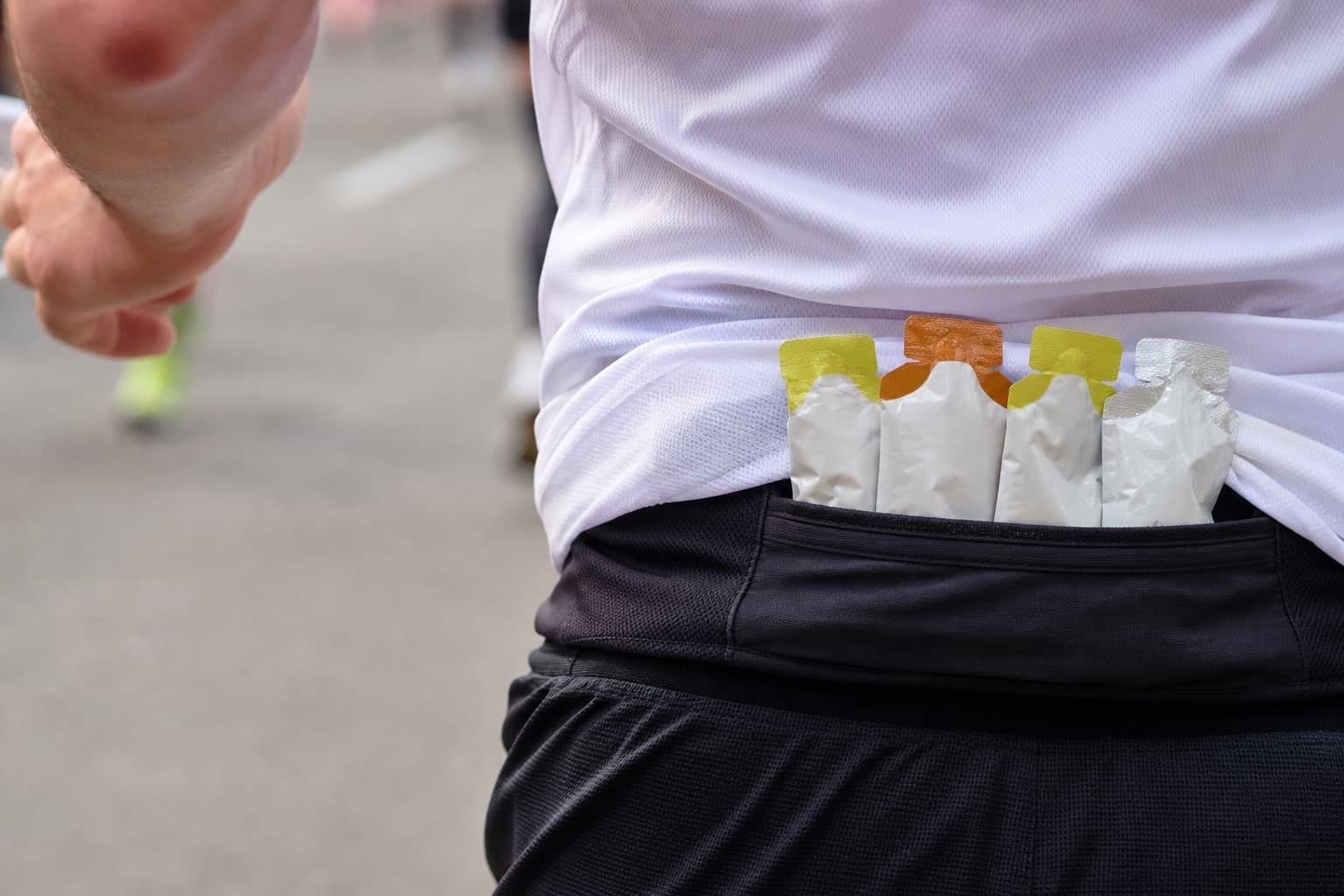
When should you start taking gels?
Start your first gel around mile 3 to 4. Do not start at the start line. Your body stores enough fuel for the first 60 to 90 minutes of running. Taking a gel too early wastes it. You cannot store the extra carbs for later in the race.
Waiting too long carries its own risk. If you wait past mile 6 or 7 for your first gel, your fuel tank may already be dipping. Your gut also needs time to start absorbing sugar well. Starting early gives it a head start before you truly need the fuel.
After your first gel, spread the rest evenly. Use a gel every 25 to 45 minutes, based on your total count from the table. Even spacing keeps your blood sugar steady. Uneven spacing, like skipping two stops and taking three gels at once, often causes stomach trouble.
Does your pace change how many gels you need?
Yes, pace changes everything here. Faster paces burn more carbs per hour. So faster runners need more gels overall, not fewer. A 2:50 marathoner works near their limit for three hours straight. Their muscles burn through carbs fast. This effort level supports intake near the 90-gram ceiling (Jeukendrup, 2014).
A 4:45 marathoner runs an easier effort for longer. Their body leans more on stored fat at that pace. They still need some carbs to avoid a late fade. But 30 grams an hour is often enough for them. This is the exact pattern shown in the table above.
Think of it like a car engine. A car cruising at low speed sips fuel slowly. The same car at full throttle burns fuel much faster. Your muscles work the same way during a marathon.

What if gels upset your stomach?
Gut trouble usually means too much sugar too fast. It is rarely about total carbs alone. Sports nutrition guidance recommends easing into higher carb rates over several long runs before race day (Burke et al., 2019). Your gut can adapt and absorb more carbs. But only with practice, not on race morning.
Try smaller doses more often instead of fewer big ones. A half gel every 15 minutes can sit better than a full gel every 30 minutes. Water helps too. Take a sip of water with each gel to help it move through your gut.
Always test your exact plan before race day. Try your brand, your timing, and your total count on a long training run. Race day is not the place to try something new. Your stomach will remember a bad experiment.
Can you use real food instead of gels?
Yes, real food can replace some or all of your gels. Many runners use chews, dried fruit, or small pieces of banana at aid stations. What matters is the total carbs, not the exact source. A pack of chews often matches one gel in carb content. Check the label to compare.
Solid food takes a bit longer to digest than a gel. This can feel better for some stomachs and worse for others. Test both types in training. Pick whichever sits well for you at race pace. Some runners even mix both. They might use gels early and switch to chews or fruit late in the race, when appetite for sweet gel flavors often drops.
Sports drinks at aid stations also carry carbs. A cup of sports drink can hold 10 to 20 grams of carbs. If you drink at every aid station, count that toward your hourly total. Skipping this step is a common mistake. Runners often double up on carbs without noticing, since they forget to count the drink.
How does hot weather change your gel plan?
Heat can shrink your appetite for gels. Blood flow shifts toward your skin to cool you down. Less blood flow reaches your gut. This can slow digestion and make gels harder to tolerate. Many runners report more stomach trouble on hot race days than cool ones.
If the forecast is hot, consider smaller, more frequent doses. A half gel every 15 to 20 minutes may sit better than a full gel every 30 minutes. Pair each gel with a small sip of water, not a full cup. Too much fluid at once can also slow your stomach down.
Cooler weather usually allows your normal gel plan without changes. Your gut works closer to normal, and appetite stays steadier. Still, always test your plan in similar conditions to race day before you commit to it. A gel that worked in a cool spring training run may not work the same way on a warm fall race morning.
Why one carbs-per-hour rule does not fit every runner
A single carbs-per-hour number cannot know your personal fitness. It cannot see your training history. It cannot see your gut tolerance. It cannot see your real finish-time pace. That is where PIRX comes in.
PIRX is a proprietary machine-learning prediction engine. It learns from your own training data, not a one-size-fits-all formula. It breaks your fitness into 5 drivers: Aerobic Base, Threshold Density, Speed Exposure, Load Consistency, and Running Economy. These 5 drivers sum to your total improvement, in seconds. From there, PIRX gives you a Projected Time with a Supported Range. You know your real finish window before you plan your fuel.
"A fueling plan is only as good as the pace estimate it is built on." That line is worth remembering before you print out any gel schedule. Guess your finish time wrong, and your carbs-per-hour math goes wrong too. PIRX reaches 98% validated prediction accuracy (PIRX users). That gives you a finish-time target worth planning fuel around.
Want to connect your pacing plan to your fueling plan? Read how to pace a marathon next. Check your exact splits in the marathon pace chart. Planning your carb load too? See carb loading before a marathon for the days before your race.
Stop guessing what your training is worth. Don't rely on generic watch algorithms that treat every runner the same. Connect your Garmin, COROS, or Strava to PIRX in under 30 seconds. See your 5 performance drivers, and get your race-time projection. Then build your gel plan around a number you can trust.
Get your own projection in seconds — free, no signup, no wearable.
Marathon Time PredictorSources
- Jeukendrup, A.E. (2014). A step towards personalized sports nutrition: carbohydrate intake during exercise. Sports Medicine. (60 g/h single-carb absorption limit; up to 90 g/h with multiple transportable carbohydrates; intake should scale with exercise intensity.)
- Burke, L.M., Jeukendrup, A.E., Jones, A.M. & Mooses, M., in International Association of Athletics Federations (2019). Consensus Statement 2019: Nutrition for Athletics. International Journal of Sport Nutrition and Exercise Metabolism. (Carbohydrate intake up to 90 g/h for races over 2 hours; gut absorption can be trained.)
Already know your number? Start your 14-day free trial