What Is a Good Running Pace? By Ability Level
On this page
Here is the direct answer. A good running pace is one that beats the average for your ability level, not one fixed number for every runner. For most adults, a good 5K race pace sits between 3:30 and 6:20 per kilometer. Your good easy pace should feel almost too slow to count as a real run. The right number depends on how long you have trained. It does not depend on your age, or on what a friend runs.
The table below shows easy pace and race pace at five ability levels. It comes from a large database of real race times.
| Ability level | Easy pace (per mile) | 5K race pace | Marathon race pace |
|---|---|---|---|
| Beginner | 11:38 – 12:08 | 10:08 /mi (6:18 /km) | 11:20 /mi (7:02 /km) |
| Novice | 9:58 – 10:28 | 8:28 /mi (5:16 /km) | 9:32 /mi (5:56 /km) |
| Intermediate (median) | 8:15 – 8:45 | 7:15 /mi (4:30 /km) | 8:12 /mi (5:06 /km) |
| Advanced | 7:21 – 7:51 | 6:21 /mi (3:57 /km) | 7:12 /mi (4:28 /km) |
| Elite | 6:41 – 7:11 | 5:41 /mi (3:32 /km) | 6:27 /mi (4:01 /km) |
Get your own projection in seconds — free, no signup, no wearable.
Race Time PredictorWhat is a good running pace?
A good running pace beats the typical runner at your level. It is not a single number for everyone. A large database of real race results sorts runners into five bands. The bands are Beginner, Novice, Intermediate, Advanced, and Elite. Each band is set by how you compare to other runners, not by a fixed target (Running Level, 2024).
An Intermediate runner sits right at the median. Half of all runners are slower. Half are faster. For a 30-year-old, median 5K pace is about 4:30 per kilometer. Median marathon pace is about 5:06 per kilometer. Move up one band, to Advanced. Pace drops to about 3:57 per kilometer. Move up again, to Elite. Pace drops to about 3:32 per kilometer.
Good pace also depends on distance, not just on ability. Your 5K pace will always be faster than your marathon pace. The gap grows the longer the race gets. Your body must save fuel for the miles still ahead. This is why the table above lists pace by distance. One number cannot cover every race.
The most useful version of "good" compares you to your own past self. A pace that was hard a year ago can be an easy pace today. Track your own trend first. Let the crowd chart be a bonus, not the main goal.
Each band also carries a rough training story. A Beginner has run for about a month. A Novice has run for about six months. An Intermediate runner has trained for two years or more. Advanced and Elite runners have often trained for five years or longer (Running Level, 2024). This means your good pace today is tied to your training age, not your years on earth. A 45-year-old who started running last spring is still a Beginner by pace, even if they feel far from new to exercise.

What is the average running pace?
The average running pace is slower than most trained runners expect. It comes from a study of 107.9 million race results. The data spans 1986 to 2018. RunRepeat did the work with the sport's top running body (Andersen, 2019). The average 5K pace is 7:04 per kilometer for men. It is 8:18 per kilometer for women.
- 107.9M
- global race results analyzed for average pace by distance (RunRepeat / IAAF, 2019)
That average includes every finisher, not just serious runners. It counts first-timers. It counts walkers. It counts people who signed up just for fun. That is why the number looks slow next to a trained runner's watch.
Average pace also shifts by distance. It does not shift the way you might guess. Runners hit their fastest relative pace in the half marathon. The study found half marathon pace is 5:40 per kilometer for men. It is 6:22 per kilometer for women. That is the quickest relative pace of any common race distance. Marathon pace is slower. It is 6:43 per kilometer for men and 7:26 per kilometer for women. The 5K has the slowest average of the four main distances. It draws every ability level. Club racers race next to total beginners on their first run.
So a slow 5K average does not mean runners are unfit. It means the 5K is the easiest race to enter with zero training. Most half marathon runners train for months before race day. They trained hard, so their average pace is faster.
Why should your easy pace feel slow?
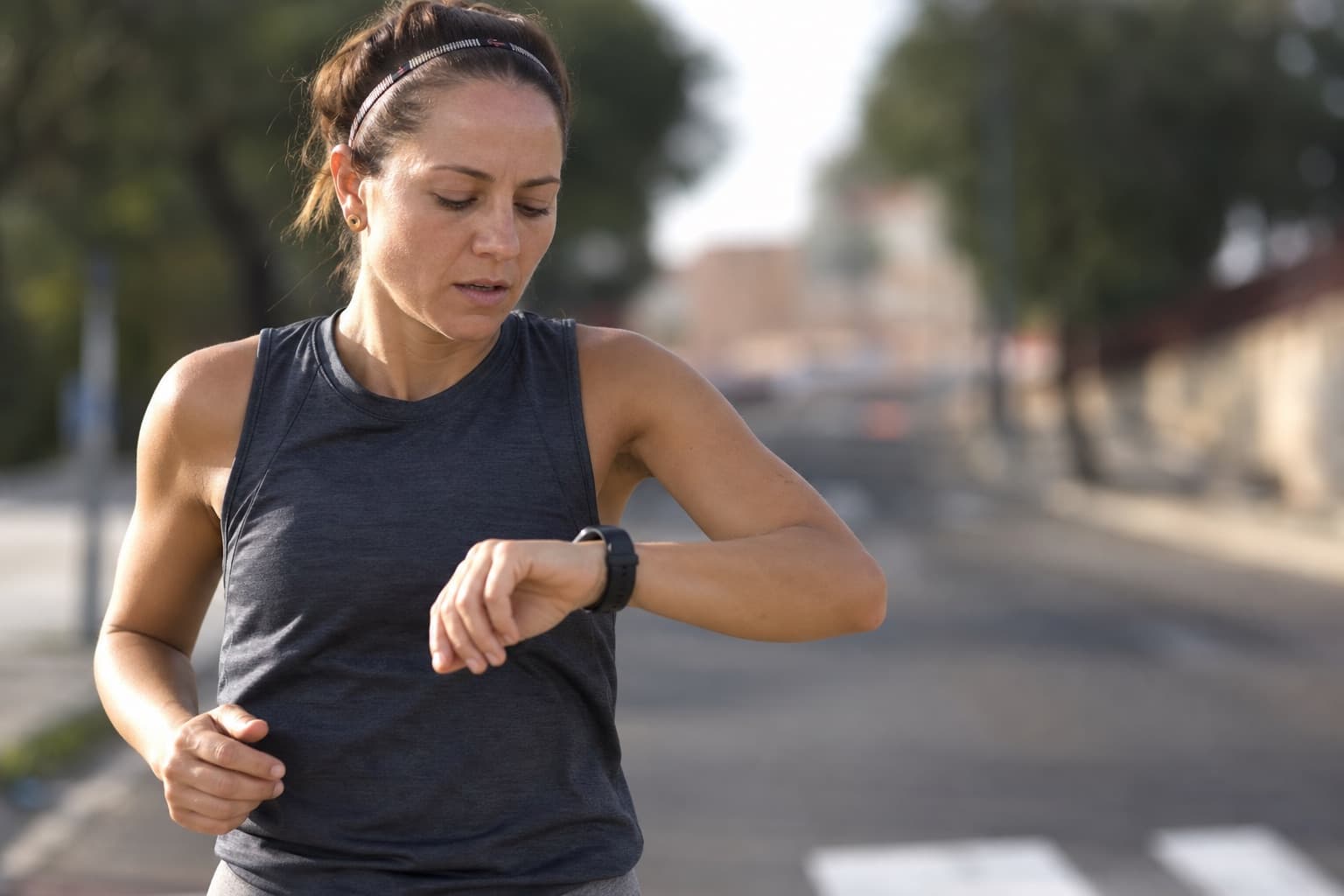
Your easy pace should feel slow. That is the whole point of an easy run. Easy runs build your aerobic engine. They do this without adding fatigue you cannot shake off. One study looked at how athletes split their hard and easy days. Runners who kept most miles slow improved more. Runners who ran medium effort every day improved less (Seiler, 2010).
- 60-90 sec
- how much slower than 5K pace a trained runner's easy pace should be, per mile
The simplest way to check your pace is the talk test. Can you speak in full sentences without gasping for air? If yes, you are in the right zone. This method has real science behind it. Studies show it matches a real shift point in your body. That is the exact spot where easy effort turns into hard effort (Kwon, 2023).
In plain terms, add 60 to 90 seconds per mile to your 5K pace. Do this on most training days. New runners often need a bigger gap. Try 90 to 120 seconds per mile instead. Your aerobic base is still forming. Give your body more room to adapt, without strain.
Look back at the table above. An Intermediate runner's easy pace sits a full minute per mile slower than 5K race pace. That gap is not wasted time. It is doing real, quiet work under the surface.
Most runners who stop improving are running their easy days too fast. The fix is not more effort on those days. It is more patience. Save your effort for the days built for it. Then those hard days can be truly hard.
How do I find my own good pace?
The fastest way to find your good pace is to run one honest race. Then read the result. A recent 5K, 10K, or half time shows your real fitness. It beats a guess based on your age or gender.
From that one race, you can build your own version of the table above. Your easy pace comes from it. Your race pace at other distances comes from it too. Your realistic goal pace does as well. All these numbers trace back to one thing. One real result, from one real race day.
This beats copying a stranger's splits off social media. Your body is not their body. Your training history is not their training history. Two runners with the same 5K time can still need very different training plans.
Two things move your good pace over time. Training consistency raises your ceiling. It happens year after year, mile after mile. Training for one distance sharpens the exact pace you want. A 5K and a marathon reward different systems inside your body. A runner who only trains short, fast efforts often has a strong 5K pace. Their marathon pace often stays rougher. The reverse is also true for runners who only train long and slow.
If you want your exact numbers, skip the age-30 table row. Enter a recent race into a free predictor. Get your own pace ladder back in seconds.
How does PIRX know my real good pace?
A chart like the one above is a starting point. It is not your ceiling. It cannot see your training history. It cannot see your recent races. It cannot see how your fitness is trending this week. PIRX is a proprietary machine-learning prediction engine. It reads your real runs. It does not guess from one table row.
PIRX breaks your fitness into 5 drivers. They are Aerobic Base, Threshold Density, Speed Exposure, Load Consistency, and Running Economy. For pace, Aerobic Base and Running Economy carry the most weight. Together, they set how much oxygen you burn to hold a given speed. Each driver reports its own effect, in seconds. All 5 drivers sum to your total change. Nothing hides inside one vague score.
From there, PIRX outputs a Projected Time for any distance. It comes with a Supported Range. That range is built from your own data, not a group average. As one PIRX coach puts it, "a pace chart tells you where the crowd stands. A projection tells you where you stand, and where your next 30 seconds are hiding." The projection recalculates after every synced run. Your paces stay current as your fitness shifts each week.
- 98%
- validated prediction accuracy (PIRX users)
This is what makes PIRX different from a generic pace chart or a wrist VO2 max guess. Both treat every runner the same. PIRX does not.
Want the full training pace ladder, from recovery to speed work? Read training paces explained. Curious if your next goal is realistic? Check is my goal time realistic. Ready to race smarter? See how to pace a 5K.
Stop guessing what your training is worth. Don't rely on generic watch algorithms that treat every runner the same. Connect your Garmin, COROS, or Strava to PIRX in under 30 seconds. See your 5 performance drivers, and get your own race-time projection, built from your own runs.
Get your own projection in seconds — free, no signup, no wearable.
Race Time PredictorSources
- Running Level (2024). 5K Run Times By Age And Ability. (Ability-level pace standards: Beginner, Novice, Intermediate, Advanced, Elite.)
- Andersen, J.J. / RunRepeat (2019). The State of Running 2019. (107.9 million race results, 1986 to 2018, with average pace by distance and gender.)
- Seiler, S. (2010). What is best practice for training intensity and duration distribution in endurance athletes? International Journal of Sports Physiology and Performance. (Mostly-easy training with a small hard share outperforms medium-effort training.)
- Kwon, Y. (2023). The talk test as a useful tool to monitor aerobic exercise intensity in healthy population. Journal of Exercise Rehabilitation.
Already know your number? Start your 14-day free trial