Cross Training for Runners: What Actually Transfers

On this page
Cycling and deep water running are the best cross training options for runners, but neither fully replaces running. Both protect your engine fitness without the impact of running. Research shows deep water running matches land training for building your engine. Cycling and running, though, do not fully swap for each other on race day.
The table below compares the main cross training options, what they carry over to running, and when to use each one.
| Modality | Transfer to running | Best use case |
|---|---|---|
| Deep water running | High for aerobic fitness, near zero impact | Injury recovery, protecting fitness while hurt |
| Cycling | Moderate for aerobic fitness, low impact | Extra aerobic volume, active recovery, high mileage weeks |
| Elliptical | Moderate, close to running motion | Easy substitute on joint rest days |
| Swimming | Low for fitness built by real running, full-body recovery | Active recovery, upper-body balance, injury periods |
Get your own projection in seconds — free, no signup, no wearable.
Race Time PredictorWhy do runners cross train at all?
Runners cross train to protect their joints. At the same time, they keep training their heart and lungs. Running hits your body with the same hit, over and over, mile after mile. Up to 79 percent of distance runners get hurt in a given year. Most of these hurts come from overuse, not a fall or a trip (Menges et al., 2026). That is a very high rate.
Cross training offers a way around some of that impact. Cycling, swimming, and pool running all work your heart and lungs hard. None of them pound your joints like running does. This lets you keep your Aerobic Base active. Aerobic Base is the driver behind your endurance engine. You can train it even when your legs need a break.
Not every runner needs cross training. A healthy runner on a normal mileage plan may not need it at all. It matters most in two cases. The first is an injury, when running is off the table. The second is a very high mileage block, when your legs need extra rest but your heart still wants work. A third case is simple variety. Some runners just enjoy a change of pace once in a while, and that simple reason is fine too.
Think of it like this. Your legs get a rest. Your heart still gets its work. That is the whole point of a smart cross training plan. It fills the gap when your legs need time off. It keeps your fitness from slipping while you wait to run again.
Does cycling transfer to your running speed?
Only in part. A recent review compared two groups. One group trained only by running. The other trained only by cycling. There was no clear gap in race results between the two (Menges et al., 2026).
That sounds like good news for cycling. But the same review found real limits too. Few studies exist on this topic. Study quality varied a lot. Here is the honest read. Cycling can help hold some fitness in place. But it does not build the same kind of fitness that real running builds.
Cycling still earns a spot in your week. It adds real work for your heart, with no extra pounding on tired legs. It works well in a high mileage week. It also works well when you want more time on the bike, not the road, on a rest day. Just do not expect the bike alone to give you all the gains that real running gives. Use it as a helper, not a full swap.
- 79%
- of distance runners are injured, mostly from overuse, in a given year (Menges et al., 2026)
Does deep water running match real running?
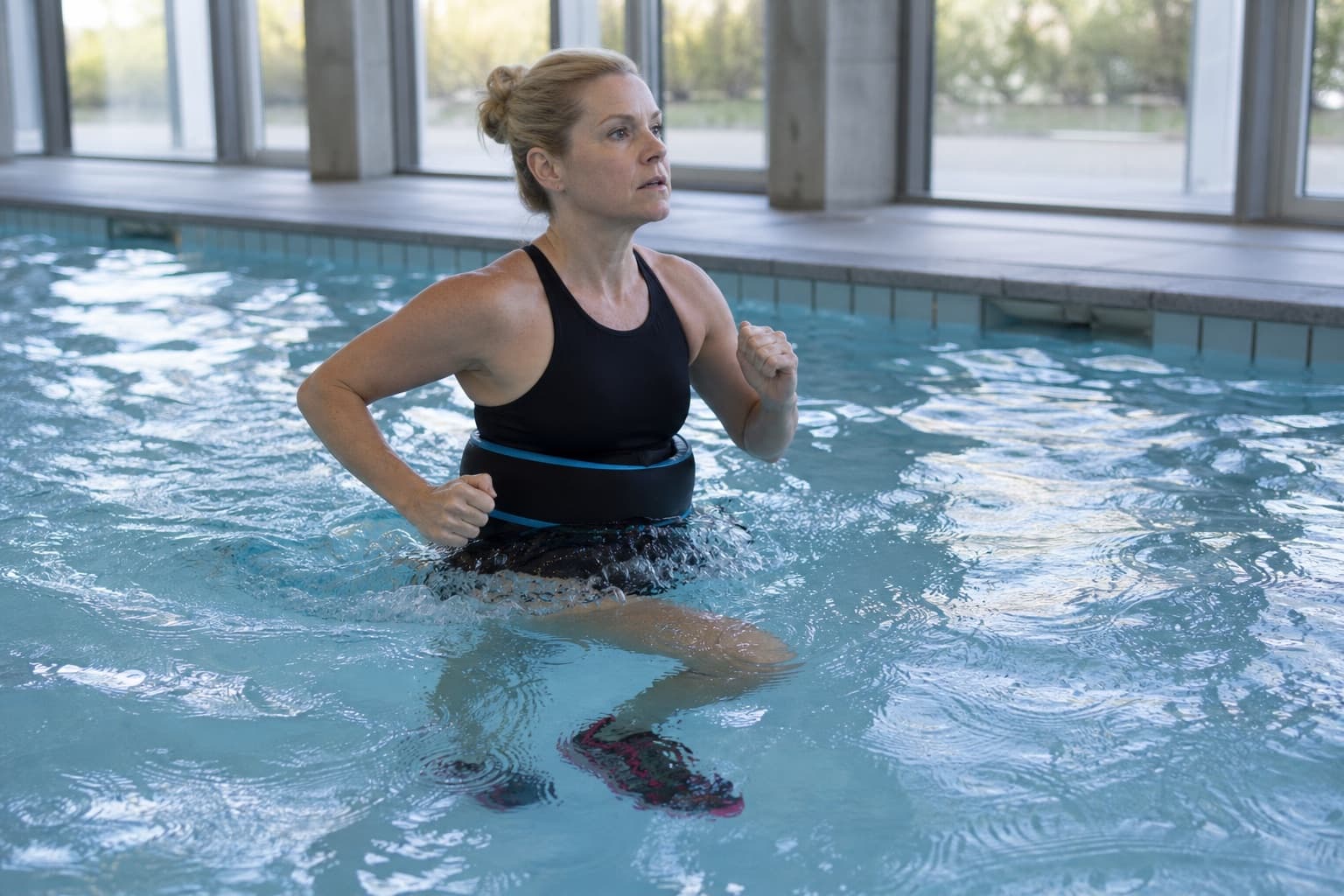
Yes, for your heart and lungs. A review pooled 11 trials on deep water running. It found deep water running built heart and lung fitness about as well as training on land did (Kwok et al., 2022).
Deep water running means running in place in a pool. The water sits at shoulder level. A float belt can help keep you upright. The water removes almost all impact on your joints. This makes it one of the best choices during an injury. Running itself may be off the table. Your heart and lungs can still get real work.
Try to match your normal running form in the water. Drive your knees forward, not just up and down. Pump your arms the same way you would on land. This helps the switch back to real running feel more natural once you are healed.
The catch is comfort and access. Deep water running needs a pool. It also takes practice. It can feel odd at first. Many runners find it strange the first few times. Stick with short sessions until it feels smooth. Give it a few tries before you judge it. Doctors and coaches often suggest it during a hurt spell. Our post on why hard training doesn't show on race day covers more on smart choices when you are hurt.
Is the elliptical a good swap for running?
Yes, for a short stretch of time. One small study tracked new runners for three weeks. Some kept running. Others switched to an elliptical machine. VO2 max held up close in both groups. It dropped just a bit more on this machine, about 1.5 percent, versus 0.8 percent for running (Joubert et al., 2011).
That gap is small. Over a short break, this machine is a fine way to keep your engine close to race shape. The leg path is also closer to a run than a bike ride or a swim. Long, multi-month data on this machine is thin. Treat it as a short-term tool, not a lasting swap for a run. Save it for a busy week or a sore-legs day, not your whole training block.

Does swimming help runners?
Yes, but mostly for recovery. Swimming works your whole body. It hits muscles that running rarely touches. It is gentle on your joints. It can help you recover between hard training blocks. A slow, easy swim on a rest day rarely does any harm at all.
What swimming does not do well is build fitness that only real running can build. Your leg muscles and tendons adapt to running by running. A hard pool workout does not train your calves and Achilles tendon the way a run does. Use swimming as a break for tired legs. Do not use it as your main tool if a faster race day is your goal. Save your hard days for the road or the track.
How does cross training tie into your Aerobic Base?
Cross training mainly supports your Aerobic Base. This is one of the five drivers behind your Projected Time. Aerobic Base reflects the engine built by steady, easy effort over time. Low impact work, like cycling or pool running, can help keep that engine ticking over. This matters most when your running volume drops.
But cross training cannot fully replace real running miles for this driver either. Real running builds a kind of engine fitness that other sports only partly reach. Use cross training to protect what you have already built. This matters most during an injury or a very high mileage week. It should not be your main way to grow fitness long term. For the training methods that do grow your running economy and your engine, see our guides on how to improve running economy and strength training for runners.
How does PIRX handle cross training in your data?
PIRX reads your synced training to build your Aerobic Base score. It does the same for your other four drivers. It sees the full picture of what you are doing. It does not just look at running mileage alone.
A generic calculator only knows your last race result. It cannot tell you if swapping two runs for cycling this week protects your fitness. It also cannot tell you if that swap quietly costs you gains built by real running. It has no way to weigh your full week of training against your goal race.
PIRX is a proprietary machine-learning prediction engine. It learns how you train. It shows where every second comes from. That means all five drivers: Aerobic Base, Threshold Density, Speed Exposure, Load Consistency, and Running Economy. Experts agree cross training can guard your fitness. It is not yet proof it builds race speed like running does. PIRX sticks to that same honest view. No hype. Just the real read on what the data shows.
- 98%
- validated prediction accuracy (PIRX users)
Protect your fitness, don't just guess at it
Stop guessing whether your cross training week is helping or hurting your progress. Don't rely on generic watch algorithms that treat every runner the same. Connect your Garmin, COROS, or Strava to PIRX in under 30 seconds. See your Aerobic Base score next to your other four drivers, and get your race time projection.
Get your own projection in seconds — free, no signup, no wearable.
Race Time PredictorSources
- Menges, T. et al. (2026). Cross training between running and cycling: effects on VO2max and running performance, a systematic review and meta-analysis. Frontiers in Sports and Active Living. (No clear speed gap between running-only and cycling-only groups. Up to 79 percent of distance runners get hurt each year, mostly from overuse.)
- Kwok, M.M.Y. et al. (2022). Effectiveness of deep water running on improving cardiorespiratory fitness, physical function and quality of life: a systematic review. International Journal of Environmental Research and Public Health. (Deep water running matched land training for heart and lung fitness in 11 trials.)
- Joubert, D.P. et al. (2011). The effects of elliptical cross training on VO2 max in recently trained runners. International Journal of Exercise Science. (VO2 max held up close over 3 weeks whether runners kept running or switched to the elliptical.)
Already know your number? Start your 14-day free trial