How to Run a Sub-3:30 Marathon

On this page
A sub-3:30 marathon means holding 4:58 per kilometer, or 8:00 per mile, for the full 42.195 km. This is the serious amateur goal. It sits well above a first finish. For many runners, it sits right at the door of a Boston qualifier. To get there you need real weekly volume and time spent at goal pace. This sub 3:30 marathon training plan gives you the pace, the splits, the mileage, and how to hold it.
| Sub-3:30 marathon target | Number to hit |
|---|---|
| Pace per kilometer | 4:58 |
| Pace per mile | 8:00 |
| 10 km checkpoint | 49:46 |
| Half checkpoint | 1:44:59 |
| 30 km checkpoint | 2:29:18 |
| Finish | 3:29:59 |
| Realistic weekly volume | 64 to 89 km (40 to 55 miles) |
Get your own projection in seconds — free, no signup, no wearable.
Marathon Time PredictorWhat pace is a 3:30 marathon?
A 3:30 marathon is 4:58 per kilometer. In miles, that is 8:00 per mile. You hold it for 26.2 miles with no break. Run even splits and you cross the line in 3:29:59.
The checkpoints map it out. You pass 10 km in 49:46. You reach halfway in 1:44:59. You hit 30 km in 2:29:18. Then 12 km remain on tired legs.
The pace is brisk but steady. Most fit runners can hold 4:58 for a short while with ease. The skill is making it last. You need 4:58 to feel calm at 35 km, not just at 5 km. The whole plan is built to stretch that pace across the full race.
What weekly mileage do you need for a sub-3:30 marathon?
Most sub-3:30 runners train 64 to 89 km per week. In miles, that is 40 to 55 miles. That is more than a first-time finisher runs. It is less than an elite amateur runs. This middle tier is the heart of the goal.
The research points the same way. One study tracked 22 marathon runners over many races. It found that two training numbers set their finish time. The first was how many kilometers they ran each week. The second was how fast they ran in training (Tanda, 2011). More weekly distance at a quicker pace meant a faster marathon.
- 64–89 km
- weekly volume tier for a sub-3:30 marathon
Keep most of those miles easy. Easy means you can talk in full sentences. Easy miles grow your engine without breaking you down. Then add one harder session each week at or near goal pace. The long run should build toward 30 to 32 km across the block. If you are stepping up from a first finish, build the base first with how to run a sub-4-hour marathon. Skipped weeks hurt more than slow weeks.
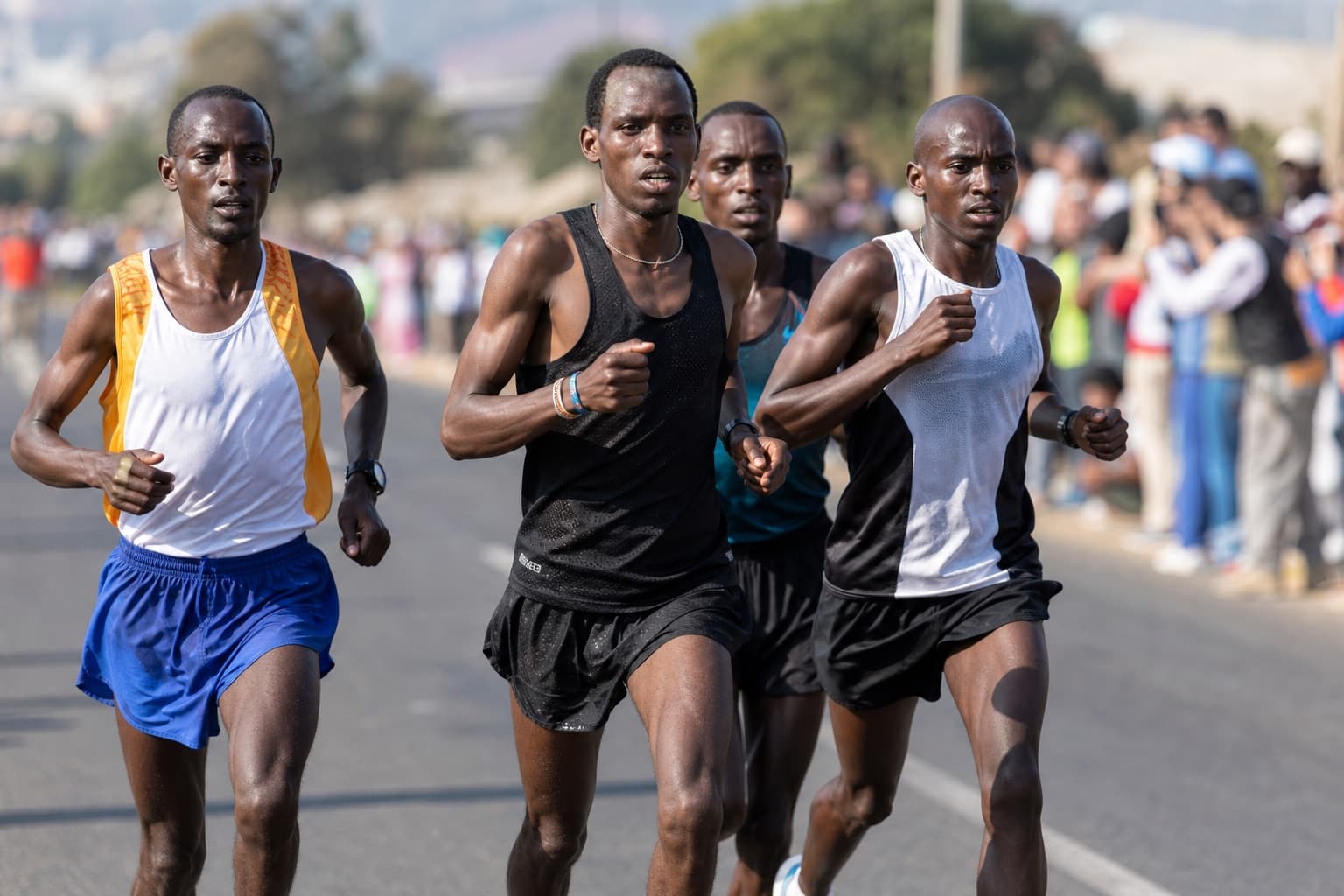
Why does marathon-pace work matter most for a sub-3:30?
Marathon-pace work is the key session for sub-3:30. It teaches your legs to feel at home at 4:58 per km. No other workout copies the race as closely.
Start with one term. Your goal pace must sit just under your lactate threshold. Threshold is the fastest pace you can hold for about an hour before fatigue floods your legs. A large review found that lactate threshold is one of the most valid markers of endurance performance (Faude et al., 2009). Raise that threshold, and 4:58 feels easier for longer.
The best place to train goal pace is inside your long run. Run the early miles easy. Then finish the last part at 4:58 per km. This is called a fast-finish long run. A review of marathon pacing names fast-finish workouts and progressive long runs as key tools to hold pace late in a race (Grivas, 2025).
Here is a simple way to build it. Early in the block, run just 5 km at 4:58 inside a longer run. As race day nears, grow that goal-pace block toward 16 to 20 km. By the end, your long run holds a big chunk at race effort. That climb is what makes the full distance feel within reach.
This works because of a simple rule. Your body learns the exact thing you practice. Run goal pace on tired legs in training, and goal pace on tired legs feels normal on race day. Skip it, and 4:58 stays foreign. That is why marathon-pace miles beat random hard running for this goal. A 3:30 race is not a sprint. It is a long, even effort. Your training should look like that effort, week after week.
Is a sub-3:30 marathon a Boston qualifier?
For many runners, a sub-3:30 marathon is at or near a Boston qualifying time. It depends on your age and your sex. That is what makes this tier feel so big.
The Boston Athletic Association sets its qualifying standards by age group and sex (Boston Athletic Association, 2026). The standards ease as you get older. So 3:30 clears the bar for some runners and falls just under it for others. Check the official BAA standards for your own group before you commit. Do not guess the number.
Even if 3:30 is not your exact cutoff, the work is the same. The volume, the goal-pace long runs, and the steady weeks that carry you to 3:30 are the same ones that carry you toward a qualifier. If your cutoff is faster than 3:30, the next step is how to run a sub-3-hour marathon. The training tier above this one is steeper, but the path is built the same way.

How do you fuel and pace to hold 4:58 to the line?
You hold 4:58 by loading carbs before the race and pacing evenly within it. Fitness gets you to the start. Fuel and pacing get you to the finish.
Start with the day before. Top off your fuel tank with a high-carb day. A 2025 review of endurance fueling suggests 10 to 12 grams of carbohydrate per kilogram of body weight to fully stock your muscle stores (Cao et al., 2025). For a 70 kg runner, that is a big carb day, not a normal one. A full tank delays the late-race slow-down.
- 10–12 g/kg
- carbohydrate to fully load muscle stores before a marathon (Cao et al., 2025)
Practice your fuel on long runs, too. Your gut needs training, just like your legs. Test your gels and your timing weeks before the race. A plan you try for the first time on race day often fails.
Then pace it with care. Start at goal pace, or a touch slower. Aim to run the second half as fast as the first, or faster. Running an even or slightly negative split spares fuel, holds your form, and delays fatigue in the late miles (Grivas, 2025). Going out too fast is the most common sub-3:30 miss. The early pace feels easy, so runners speed up. Then they pay for it at 32 km. Bank patience, not seconds. For a full split plan, read how to pace a marathon.
Why does PIRX beat one-size-fits-all calculators?
A one-size-fits-all calculator takes one race time and hands back one number. It treats every runner the same. It cannot tell if your goal-pace volume is thin, or if your long run is too short for 3:30. So it gives the same answer to two very different runners.
PIRX is a proprietary machine-learning prediction engine. It reads your real runs, not just a finish time. It breaks your fitness into 5 drivers: Aerobic Base, Threshold Density, Speed Exposure, Load Consistency, and Running Economy. Each driver gets a score. The lowest score is your gap to 3:30.
Then it shows the gain in seconds, not a percent. Say your Threshold Density is thin, and that gap costs you 70 seconds over the marathon. You see that exact number. You know what to train next.
PIRX gives you a Projected Time with a Supported Range. The Supported Range is the band your finish should land in. It recalculates after every synced activity. A visible change shows only when the structural change is at least 2 seconds. So you track real progress, not noise.
- 98%
- validated prediction accuracy (PIRX users)
See if sub-3:30 is inside your range
Stop guessing whether 3:30 is in reach. Generic watch algorithms treat every runner the same, and they cannot see your goal-pace work. PIRX can. Connect your Garmin, COROS, or Strava in under a minute. See your 5 performance drivers. Find where your seconds come from. Then check if sub-3:30 sits inside your Supported Range before you commit a whole training block to it. Free, no signup needed.
Get your own projection in seconds — free, no signup, no wearable.
Marathon Time PredictorSources
- Tanda, G. (2011). Prediction of marathon performance time on the basis of training indices. Journal of Human Sport and Exercise, 6(3), 511-520. (Across 22 marathon runners, weekly training distance and training pace together predicted marathon finish time.)
- Faude, O., Kindermann, W. & Meyer, T. (2009). Lactate threshold concepts: how valid are they? Sports Medicine, 39(6), 469-490. (Lactate threshold shows strong links with endurance performance, making it a valid performance marker for pacing.)
- Grivas, G.V. (2025). The physiology and psychology of negative splits: insights into optimal marathon pacing strategies. Frontiers in Physiology. (Even and slightly negative pacing spares glycogen and delays fatigue; fast-finish workouts and progressive long runs help runners hold pace late.)
- Cao, W. et al. (2025). A Review of Carbohydrate Supplementation Approaches and Strategies for Optimizing Performance in Elite Long-Distance Endurance. Nutrients, 17(5), 918. (For long endurance events, loading 10 to 12 grams of carbohydrate per kilogram of body weight before the race fully stocks muscle glycogen.)
- Boston Athletic Association. (2026). Boston Marathon Qualifying Standards. baa.org. (Official qualifying times are set by age group and sex and ease with age; runners should check their own standard rather than assume a single cutoff.)
Already know your number? Start your 14-day free trial