Does Cold Weather Slow Your Running Pace?

On this page
Cold weather slows you down a little, but far less than heat does. Cool air is actually close to the best racing weather there is. The fastest window sits near 4 to 12°C, which is 40 to 54°F. Below that, cold muscles cost you a few seconds. The good news is you can erase most of that cost by warming up well and dressing right.
| Air temperature | Effect on your race pace |
|---|---|
| Optimal: 4 to 12°C (40 to 54°F) | Your fastest window. This is the baseline target. Cool air lets your body shed its heat with no extra cost, so more energy goes into pace. |
| Cold: near 0°C (32°F) | A small cost. Cool muscles make less force, so pace runs about 1 to 2 percent slower. That is roughly 15 to 30 seconds on a 50-minute 10K. |
| Very cold: below -12°C (10°F) | A bigger cost. Coaches advise slowing about 27 seconds per mile. Ice underfoot and hard wind can add even more time. |
| Hot: 25°C (77°F) and up | The largest cost by far. Fast runners slow 3 to 5 percent, and most runners lose minutes on a marathon, not seconds. |
Get your own projection in seconds — free, no signup, no wearable.
Race Time PredictorDoes cold weather make you run slower?
Cold makes you a little slower, but the effect is small near freezing. Your muscles work best when they are warm. When they cool down, they make less force with each stride. So you have to work a bit harder to hold the same pace.
How much do you lose? Near 0°C, or 32°F, plan on about 1 to 2 percent. On a 50-minute 10K that is roughly 15 to 30 seconds. On a 4-hour marathon it is a few minutes at most. That is real, but it is small.
The cost climbs when it gets truly cold. Below about -12°C, or 10°F, one widely used coaching guide says to slow your pace by about 27 seconds per mile (Runner's World, 2018). Ice, snow, and wind make it worse. You take shorter, more careful steps. Footing, not fitness, sets your pace.
Here is the key point. Mild cold is one of the kindest conditions a runner can get. Heat hurts you far more. So a cold race day is not bad news. It is often a gift.
What is the best temperature for racing?
The best racing temperature is cool, near 4 to 12°C, which is 40 to 54°F. This is the sweet spot. It is warm enough that your muscles are not stiff, and cool enough that your body can dump heat with ease.
The data backs this up. A large study looked at about 1.8 million marathon finishers across six big races. The fastest times came when it was cool, near 4 to 10°C (El Helou et al., 2012). As races got warmer, the whole field slowed down.
- 4 to 12°C
- the cool sweet spot for your fastest race times
Reviews of elite marathons land in the same place. They point to an ideal near 10 to 12°C, with times as low as 8°C still very fast (Knechtle et al., 2021). So both mass-race data and elite data agree. Cool wins.
Why is cool faster than hot? When you run, your body makes a lot of heat. On a warm day it cannot shed that heat fast enough. So your pace drops to keep you safe. On a cool day, that problem mostly goes away. The heat leaves your body, and your pace stays.
This is why picking a cool-season race is a smart move. You set yourself up to run your best.
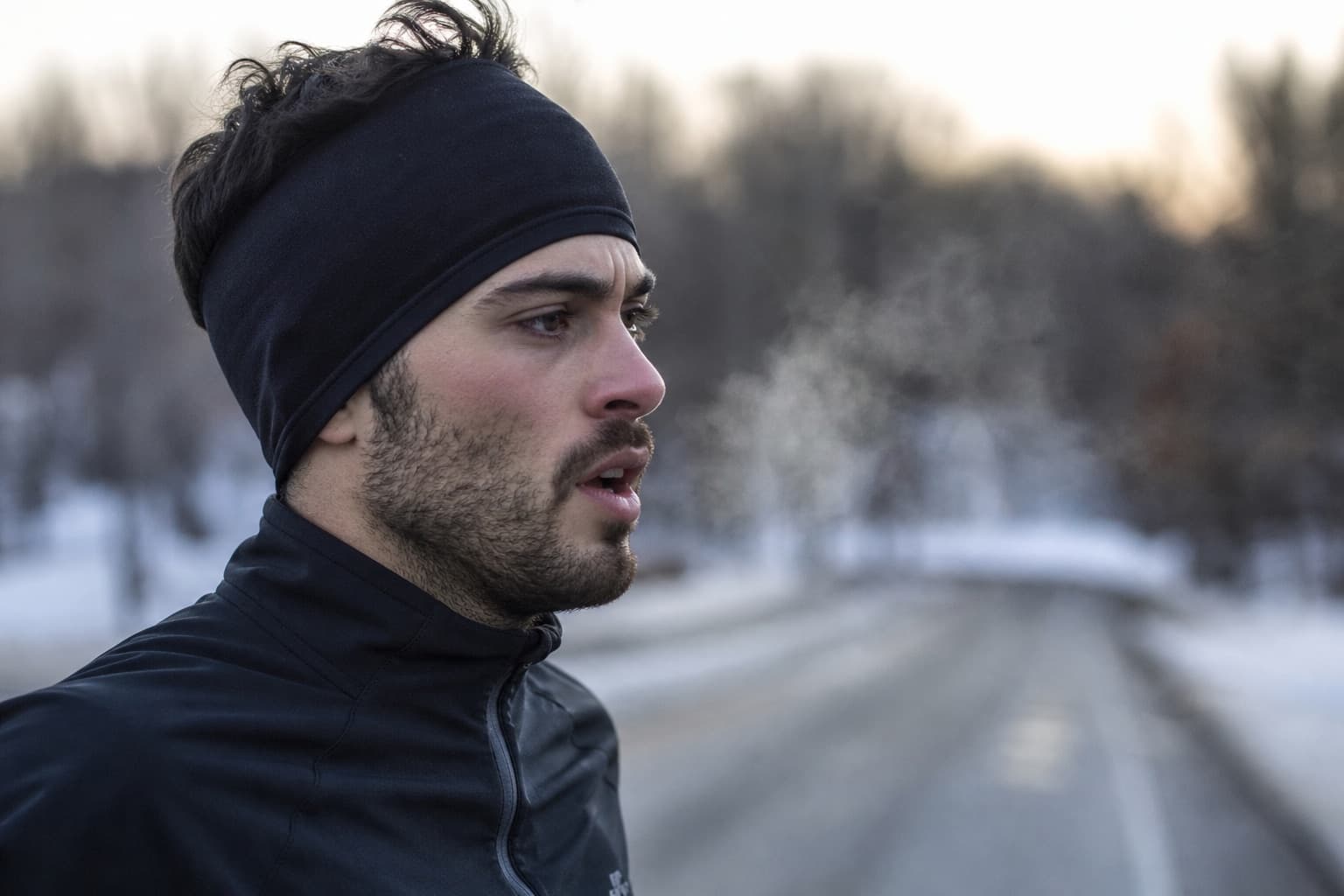
Why does cold cost you some speed?
Cold costs you speed mainly because cool muscles make less force. This is the core reason a freezing run feels a touch slower. The science here is old and solid.
In a classic study, researchers cooled and warmed muscles and measured the output. As muscle temperature dropped, both peak force and power fell (Bergh and Ekblom, 1979). Warm muscle is springy and fast. Cold muscle is stiff and slow. To run the same pace with weaker muscle, you spend more effort.
There is a second cost. Cold muscle also burns more fuel for the same work. One lab study showed that muscle used more oxygen per unit of work at a lower temperature than at a higher one (Seebacher et al., 2014). In plain terms, your running economy drops a bit when you are cold. You pay more energy for each kilometer.
Put those two together and you get the small slowdown. Less force per stride, plus a higher fuel cost, equals a few extra seconds. The colder the muscle, the larger both effects grow.
The fix is simple and it is in your hands. Warm the muscle before you race. A good warm-up wakes the muscle up. It raises the muscle temperature toward its best range. That alone claws back most of the lost seconds.
How cold is too cold to race fast?
There is no hard cutoff, but pace really starts to suffer well below freezing. Down to around 0°C, or 32°F, the cost stays small. Below about -12°C, or 10°F, it grows fast.
Two things drive the drop in deep cold. First, the muscle force loss we just covered gets larger. Second, the ground and the air turn against you. Ice and packed snow force short, cautious steps. Your stride shrinks. Your pace falls, no matter how fit you are.
Breathing changes too. Very cold, dry air can feel harsh in the throat and chest. It does not damage healthy lungs, but it can make hard efforts feel rougher than the clock says they should. Many runners cover the mouth with a buff to warm the air a little.
So how cold is too cold? For a race effort, deep cold below -12°C is where you should drop your goal pace on purpose. Use the table above. Slow down, run by effort, and treat a finish on icy footing as a win.
For most runners in most winters, the cold is not the real limiter. The footing is. Clear, dry pavement at 0°C is a fine day to race. The same temperature on sheet ice is not.

How should you dress so cold does not slow you?
Dress as if it is about 10°C, or 20°F, warmer than the real temperature. This is the most useful cold-running rule there is. You make a lot of heat once you start moving. If you dress for how cold it feels standing still, you will overheat fast.
Overdressing is its own trap. Too many layers make you sweat. Wet clothing then chills you and adds weight. You feel sluggish, and your pace pays for it. The first mile should feel slightly cold. If you are warm at the start line, you are wearing too much.
Build your layers with a plan. Start with a thin layer that pulls sweat off your skin. Add a light, breathable layer on top for wind. Save heavy layers for easy days, not race efforts. Cover the spots that lose heat fastest: hands, ears, and head.
Then warm up with real movement. Easy jogging and a few short strides raise your muscle temperature before the gun. This matters more in the cold than in mild weather. A warm muscle makes more force and uses less fuel, which is exactly what the cold takes away.
Dress smart and warm up well, and the cold barely shows up in your finish time. The runners who struggle in winter are often the ones who skip the warm-up or wear too much.
How does PIRX handle cold weather and your pace?
PIRX builds your race target from your real fitness, then you adjust it for the day. Most calculators cannot do this. They use a single fixed formula. They treat every runner the same and ignore the weather entirely.
PIRX is a proprietary machine-learning prediction engine. It learns your body from your own runs. It breaks your fitness into five drivers: Aerobic Base, Threshold Density, Speed Exposure, Load Consistency, and Running Economy. These drivers add up, in seconds, to show where your time comes from.
Two of those drivers matter most in winter. Cold air nudges your Running Economy down, since cool muscle burns more fuel per kilometer. And Load Consistency rewards the runners who keep training through the cold months instead of stopping. Steady winter miles protect your fitness for a spring race.
- 98%
- validated prediction accuracy (PIRX users)
The result is a Projected Time with a Supported Range, which shows the spread of likely finish times for your current fitness. It recalculates after every synced activity. A visible change shows only when the structural change is at least 2 seconds, so you see real progress, not noise. From that honest baseline, you add a few seconds for cold or many minutes for heat.
New to all this? Start with the complete guide to predicting your race time. For the full weather picture, see how to adjust your race time for heat, hills, and wind. And to understand why a static tool falls short, read why static race calculators are inaccurate.
Race the temperature you actually get
Stop guessing what the weather does to your goal. A cool day near 4 to 12°C is close to the best racing weather there is, so target it when you can. A cold day costs only a few seconds once you warm up and dress right. A hot day is the one to truly fear, and a smart target plans for it.
Connect your Garmin, COROS, or Strava to PIRX in under a minute. See your five drivers and your real Projected Time. Then adjust that number for the day in front of you. Once your target is honest, run by effort and trust your plan. Good pacing finishes the job, so see how to pace a marathon before race day. Free, no signup needed.
Get your own projection in seconds — free, no signup, no wearable.
Race Time PredictorSources
- El Helou, N., Tafflet, M., Berthelot, G., et al. (2012). Impact of environmental parameters on marathon running performance. PLoS ONE. (About 1.8 million finishers; the fastest times came near 4 to 10°C, with the whole field slowing as races got warmer.)
- Knechtle, B., et al. (2021). The Optimal Ambient Conditions for World Record and World Class Performances at the Berlin Marathon. Frontiers in Physiology. (Reviews place the ideal racing temperature near 10 to 12°C, with times as low as 8°C still very fast.)
- Bergh, U., & Ekblom, B. (1979). Influence of muscle temperature on maximal muscle strength and power output in human skeletal muscles. Acta Physiologica Scandinavica. (Peak muscle force and power fall as muscle temperature drops.)
- Seebacher, F., Tallis, J. A., & James, R. S. (2014). The cost of muscle power production: muscle oxygen consumption per unit work increases at low temperatures. Journal of Experimental Biology. (Muscle used more oxygen per unit of work at a lower temperature, meaning a higher energy cost when cold.)
- Runner's World. (2018). Is It Harder to Run in the Cold? (Coaching guidance recommends slowing pace by about 27 seconds per mile when it is below 10°F.)
Already know your number? Start your 14-day free trial