Trail vs Road: Why Your Pace Doesn't Transfer
On this page
Your road pace does not transfer to the trail, and that is normal. Soft, uneven ground costs you energy. Climbs cost more time than descents give back. And rough footing makes you slow down to stay upright. So the same effort that feels like a fast road pace reads much slower on a trail. The fix is simple: run trails by effort, not by your road pace.
| Terrain or elevation | Approximate penalty versus flat road |
|---|---|
| Soft or uneven flat trail (dirt, sand, gravel) | About 5% more energy at the same pace |
| Technical trail (roots, rocks, mud) | About 10 to 11% more energy than smooth ground |
| A steady 5% climb | A 6:00 per mile flat effort runs near 7:40 per mile |
| Net elevation gain on a hilly trail | The climb costs far more time than the drop gives back |
| Total climbing (hiking rule of thumb) | Add about 1 hour for every 600 m you go up |
Get your own projection in seconds — free, no signup, no wearable.
Race Time PredictorWhy is trail running slower than road?
Trail running is slower because the ground works against you. On a road, the surface is hard, flat, and even. Your foot lands and pushes off with very little wasted energy. On a trail, none of that holds. The ground is soft. It is uneven. It moves under your feet. So each step costs more, and you go slower at the same effort.
There are three reasons the trail slows you down. First, the surface soaks up energy. Second, the hills cost more going up than they pay back coming down. Third, the rough footing forces you to slow and pick your line. Put them together, and a trail pace and a road pace are not the same thing. They never will be.
This is why a flat road time tells you little about a trail time. The two runs use your legs in very different ways. So the smart move is to stop matching your road number on the trail. Pace by effort there. Keep pace targets for the road, where they actually work.
How much does soft, uneven ground slow you down?
Soft, uneven ground costs you about 5 percent more energy at the same pace. That extra cost comes from balance. On a flat road, your foot lands the same way each time. On a trail, every step is a little different. Your muscles fire harder to keep you steady.
Researchers tested this on a treadmill with a rough, uneven surface. Runners burned about 5 percent more energy on the uneven ground than on smooth ground at the same speed (Voloshina and Ferris, 2015). Their stride also changed. The body works harder just to stay balanced.
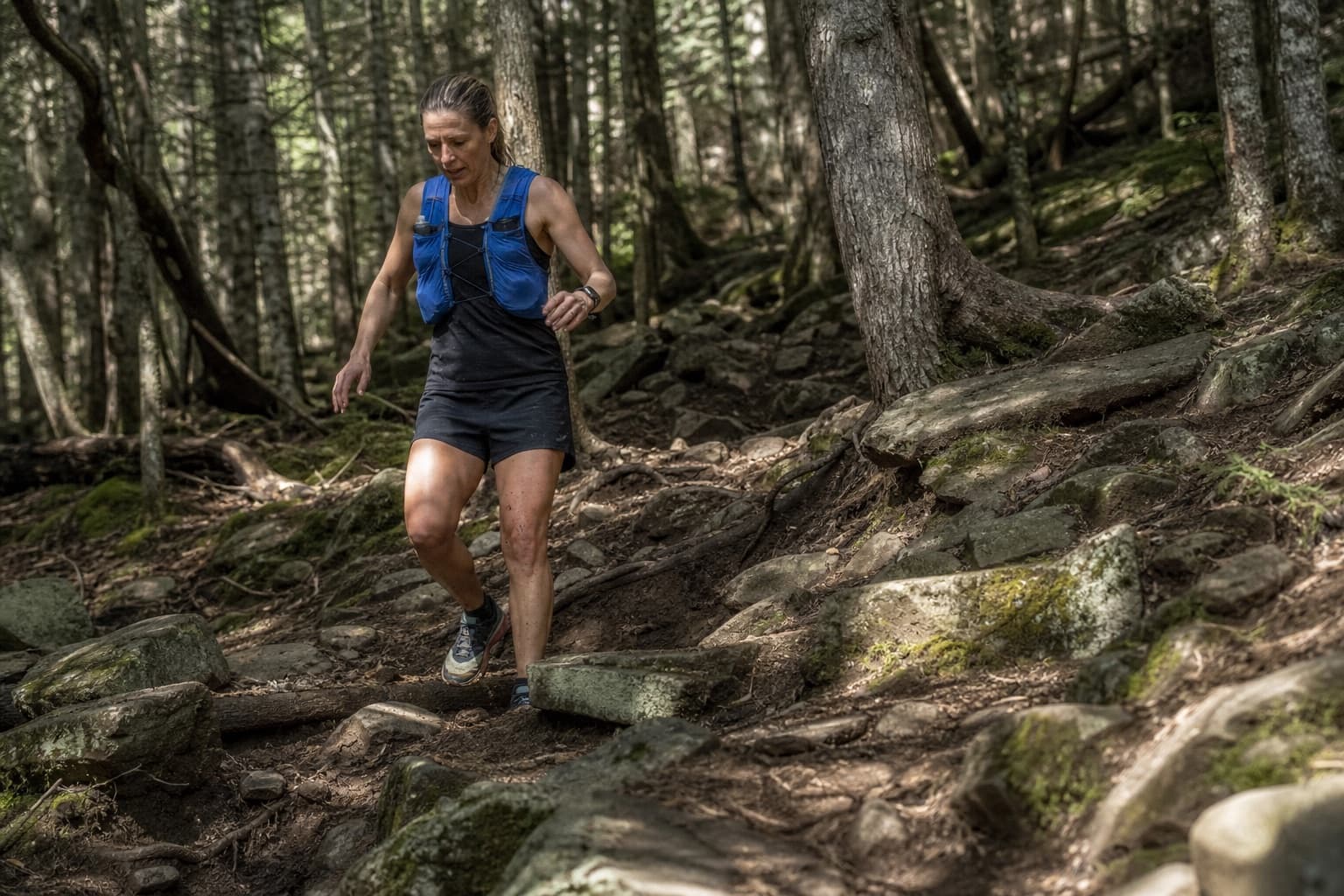
A real trail is worse than a treadmill. Outdoors you get roots, rocks, mud, and loose rock. That kind of ground is called technical. One study had runners climb a technical trail, then matched the same slope and speed on a treadmill. The technical trail burned about 10 to 11 percent more energy than the treadmill (Nicot et al., 2021).
- 11%
- more energy on a technical trail than smooth ground (Nicot et al., 2021)
The same study showed why. On the rough trail, side-to-side foot motion more than doubled. Cadence dropped by about 4.6 percent on the hardest ground, as runners reached over rocks and roots (Nicot et al., 2021). All that extra motion is energy you do not spend moving forward. So you slow down.

How much do the hills cost you?
Hills are the biggest reason trail times lag road times, and the cost is one-sided. Going up takes a lot more energy than going down gives back. So a climb is not paid for by the descent that follows it.
Scientists measured the energy cost of running at many slopes. On flat ground, running costs about 3.4 units of energy per meter. On a steep climb, that cost rose to about 19 units. On a downhill, the best case dropped to about 1.7 units (Minetti et al., 2002). The uphill cost is huge. The downhill saving is small.
That gap is why net climbing always slows you down. A flat course and a hilly course are not the same race, even over the same distance. On a trail with real climbing, you lose minutes, not seconds.
Here is what that means for pace. A grade-adjusted view of Minetti's data shows that a 6:00 per mile effort on flat ground turns into about a 7:40 per mile pace on a steady 5 percent climb. Same effort. Much slower clock. The hill, not your fitness, ate the time.
Downhills have a hidden cost too. Hard descending pounds your legs and tires them out. So a hilly trail can wear you down twice, once on the way up and once on the way down. We cover the full hill math in our guide on how to adjust your race time for heat, hills, and wind.
How much time does elevation gain add?
Climbing adds a rough, knowable chunk of time, and a simple rule shows how much. The classic one comes from hiking. It says add about 1 hour for every 600 meters you climb, on top of your flat-ground time (Naismith, 1892). That works out to roughly 1 minute for every 10 meters of climb.
That rule is for walking, so it is a ceiling, not a target. A fit trail runner adds less time than a hiker. But the lesson holds: vertical gain is its own clock. The more you climb, the more time the climb takes, no matter how hard you push.
So when you size up a trail run, do not just look at the distance. Look at the total climb. A flat 10K and a 10K with 400 meters of gain are not close. The hilly one can take far longer, even at a harder effort.
This is why trail runners talk in vertical gain, not just miles. The vert is half the story. A short, steep route can take longer than a long, flat one. Plan for the climb, and your time goal will be honest.
Why should you pace a trail by effort, not pace?
Pace trails by effort because the same pace means a different effort on every slope and surface. On a road, a steady pace equals a steady effort. On a trail, that link breaks. The number on your watch lies about how hard you are working.
The science is clear on this. When runners ran on a climb at a pace that was supposed to match a flat effort, their bodies were not fooled. At grades of 6 percent and steeper, their oxygen use, heart rate, and blood lactate all jumped well above the matched flat run (Foreman et al., 2024). The pace looked equal. The effort was not.
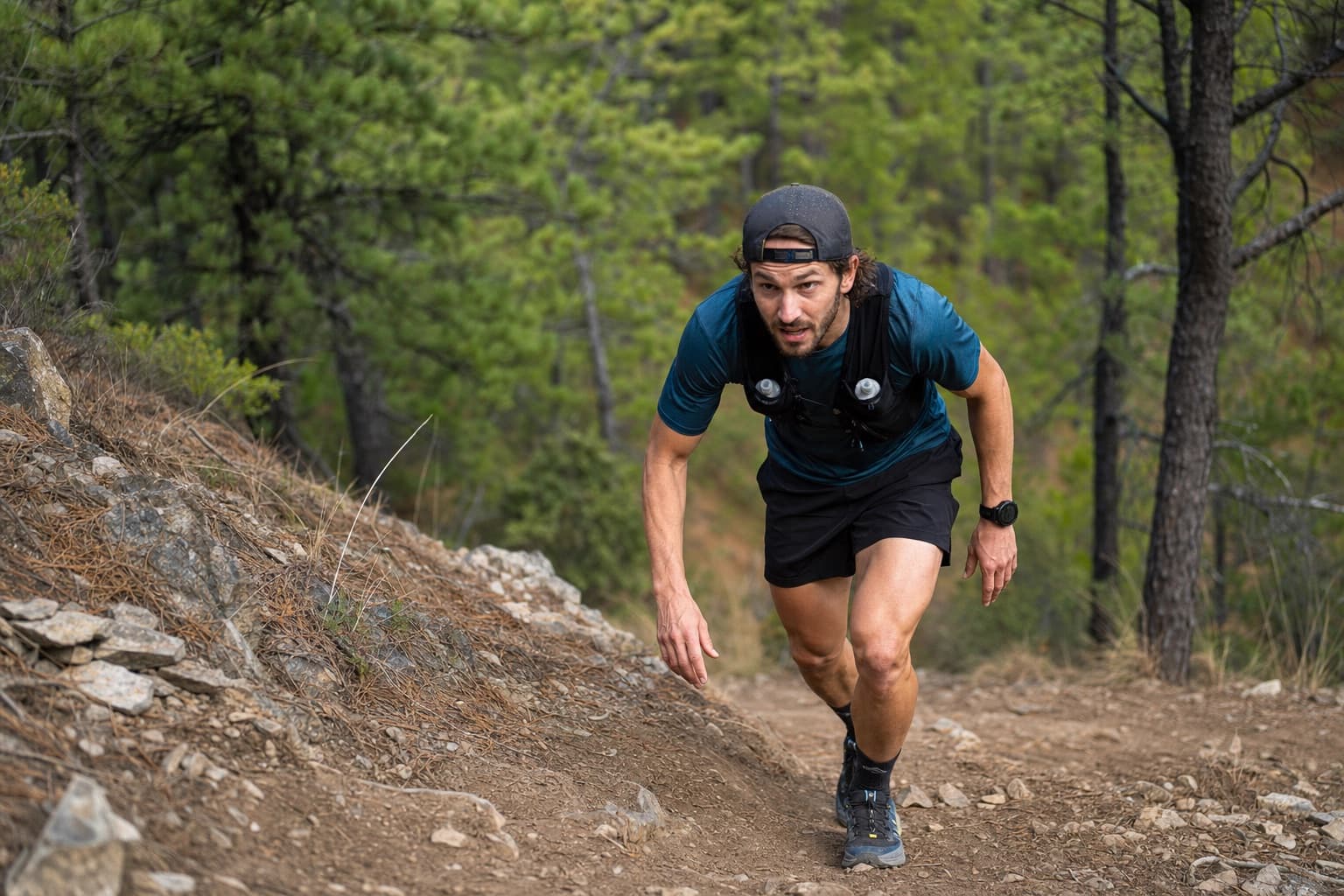
So chasing a pace number uphill just burns you out early. You blow up on the climbs and crawl to the finish. The better plan is to hold a steady effort and let pace move with the ground. Ease off going up. Stay smooth going down. Watch your breathing and heart rate, not your pace.
This is the same idea behind good road pacing, just turned up. Even on the road, effort beats blind pace chasing late in a race. See our guide on how to pace a marathon for the road version. On trails, effort is not a nice-to-have. It is the only thing that works.
How do you compare trail and road times?
You do not compare them by pace, because pace does not carry across surfaces. A road pace is built on smooth, flat ground. The trail takes that ground away. So your trail pace will almost always look slower, even when you are fitter and trying harder.
Compare them by effort instead. A hard trail run and a hard road run can share the same heart rate and the same breathing, while the paces sit minutes apart. The effort is the honest match. The pace is not.
This is also why you should not feed a trail time into a flat-distance predictor and expect a real answer. A predictor built for road distances assumes road ground. Give it a slow, hilly trail time, and it will read your fitness as lower than it is. Anchor your effort to a clean road number, then run the trail by feel.
If you are new to performance prediction, start with the complete guide to predicting your race time. It explains how a real fitness number is built, and why surface and terrain change what that number can do.
Why is PIRX built for road pace, and what does that mean for trails?
PIRX is built for road distances, and that is on purpose. Its core predictor reads your running and gives you a Projected Time for a 5K, 10K, half, or full marathon on a measured, road-style course. So your PIRX number is a flat-ground number. It is your honest baseline, not a trail target.
That baseline still helps you on trails. PIRX is a proprietary machine-learning prediction engine. It reads your real runs and breaks your fitness into five drivers: Aerobic Base, Threshold Density, Speed Exposure, Load Consistency, and Running Economy. These drivers add up, in seconds, to show where your time comes from. A bigger Aerobic Base, for example, means you can hold a steady effort longer, which is exactly what long climbs demand.
A one-size-fits-all calculator cannot do this. It takes one race time and spits out another. It cannot see your training, and it cannot tell road fitness from trail effort. PIRX learns your body from your own runs, then recalculates after every synced activity. A visible change in your Projected Time shows only when the structural change is at least 2 seconds, so you see real progress, not noise.
So use PIRX the right way for trails. Get your road Projected Time. Treat it as your fitness anchor. Then run the trail by effort, knowing the surface and the vert will add time no formula can erase.
- 98%
- validated prediction accuracy (PIRX users)
Get your real road number, then run the trail by feel
Stop forcing your road pace onto the trail. The soft ground, the climbs, and the rough footing will slow you down no matter how fit you are, and that is fine. Connect your Garmin, COROS, or Strava to PIRX in under a minute. See your five drivers and your real Projected Time on a road distance. Use that number as your fitness anchor, then head to the trail and pace by effort. Free, no signup needed.
Get your own projection in seconds — free, no signup, no wearable.
Race Time PredictorSources
- Voloshina, A. S., & Ferris, D. P. (2015). Biomechanics and energetics of running on uneven terrain. Journal of Experimental Biology. (Running over uneven ground cost about 5 percent more metabolic energy than smooth ground at the same speed.)
- Nicot, F., et al. (2021). Effect of ground technicity on cardio-respiratory and biomechanical parameters in uphill trail running. European Journal of Sport Science. (Technical uphill trails burned about 10 to 11 percent more energy than matched treadmill running; cadence dropped and side-to-side foot motion more than doubled.)
- Minetti, A. E., Moia, C., Roi, G. S., et al. (2002). Energy cost of walking and running at extreme uphill and downhill slopes. Journal of Applied Physiology. (Uphill running costs far more energy than downhill running saves; the basis for grade-adjusted pace.)
- Foreman, N. A., Lee, E. J., & Lundstrom, C. J. (2024). Assessment of a treadmill speed incline conversion chart: a validation study. International Journal of Sports Physiology and Performance. (At grades of 6 percent and above, supposedly equal pace stages still raised oxygen use, heart rate, and blood lactate.)
- Naismith, W. W. (1892). Naismith's rule. (A walking rule of thumb: add about 1 hour for every 600 meters of ascent, or roughly 1 minute per 10 meters climbed.)
Already know your number? Start your 14-day free trial