First Marathon Mistakes That Cost Runners the Most

On this page
Here is the direct answer. The four biggest first marathon mistakes are going out too fast, skipping a fuel plan, peaking too early, and wearing new gear. Each one is avoidable. Each one has wrecked thousands of first marathons. The runners who made these mistakes often trained hard enough to finish strong. One small planning error still cost them the race.
| Mistake | Consequence | Fix |
|---|---|---|
| Going out too fast | Hard crash between mile 18 and 22 | Start at or below goal pace, hold back the first 10 km |
| No fuel plan | Empty tank, dizzy or weak late | Practice 30-60g carbs per hour in training |
| Peaking too early | Tired, flat legs on race day | Taper properly, cut volume in the final 2 weeks |
| New gear on race day | Blisters, chafing, forced walk breaks | Race in shoes and socks with 30+ training miles |
Get your own projection in seconds — free, no signup, no wearable.
Marathon Time PredictorWhat are the most common first marathon mistakes?
The most common first marathon mistakes are going out too fast, skipping a fuel plan, cutting the taper short, and racing in untested gear. Every one of these is a planning problem. None of them are a fitness problem. A runner can train well for 16 weeks and still have a bad race. One of these four things going wrong is often the reason.
The good news is that all four are fixable. None of them require more training. They require a plan made in the weeks before race day. They do not require decisions made in the moment, on tired legs, under race-day stress.
This matters because first-time marathoners often focus all their energy on training miles. They spend far less time planning pace, fuel, taper, and gear. Those four choices can matter just as much as the training itself.
Why is going out too fast the biggest first marathon mistake?
Going out too fast is the biggest first marathon mistake. It drains your fuel early. The damage does not show up until it is too late to fix. A large study tracked pacing data from 1.7 million recreational marathon finishers. Runners who ran their first 5 km 10 percent too fast added about 37 minutes to their finish time. Runners who started 10 percent slower added only about 29 minutes. Most Personal Bests came from runners who ran close to even pace from the start (Smyth, 2018).
- ~37 min
- added to average finish time when the first 5K is run 10% too fast (Smyth, 2018, 1.7M+ finishes)
That number is stark for a reason. Adrenaline and fresh legs make goal pace feel too easy in the first mile. That feeling is not reliable. The fix is simple, even if it feels strange in the moment. Start at or slightly below your real goal pace. Hold that pace through the first 10 km. Do this even when your legs want to go faster.
Most first-time marathoners do not plan to go out too fast. It happens by accident. The crowd around you is moving fast. Your legs feel fresh. Goal pace feels almost too slow to bother with. That feeling fades by mile 16. Regret replaces it, one second at a time.
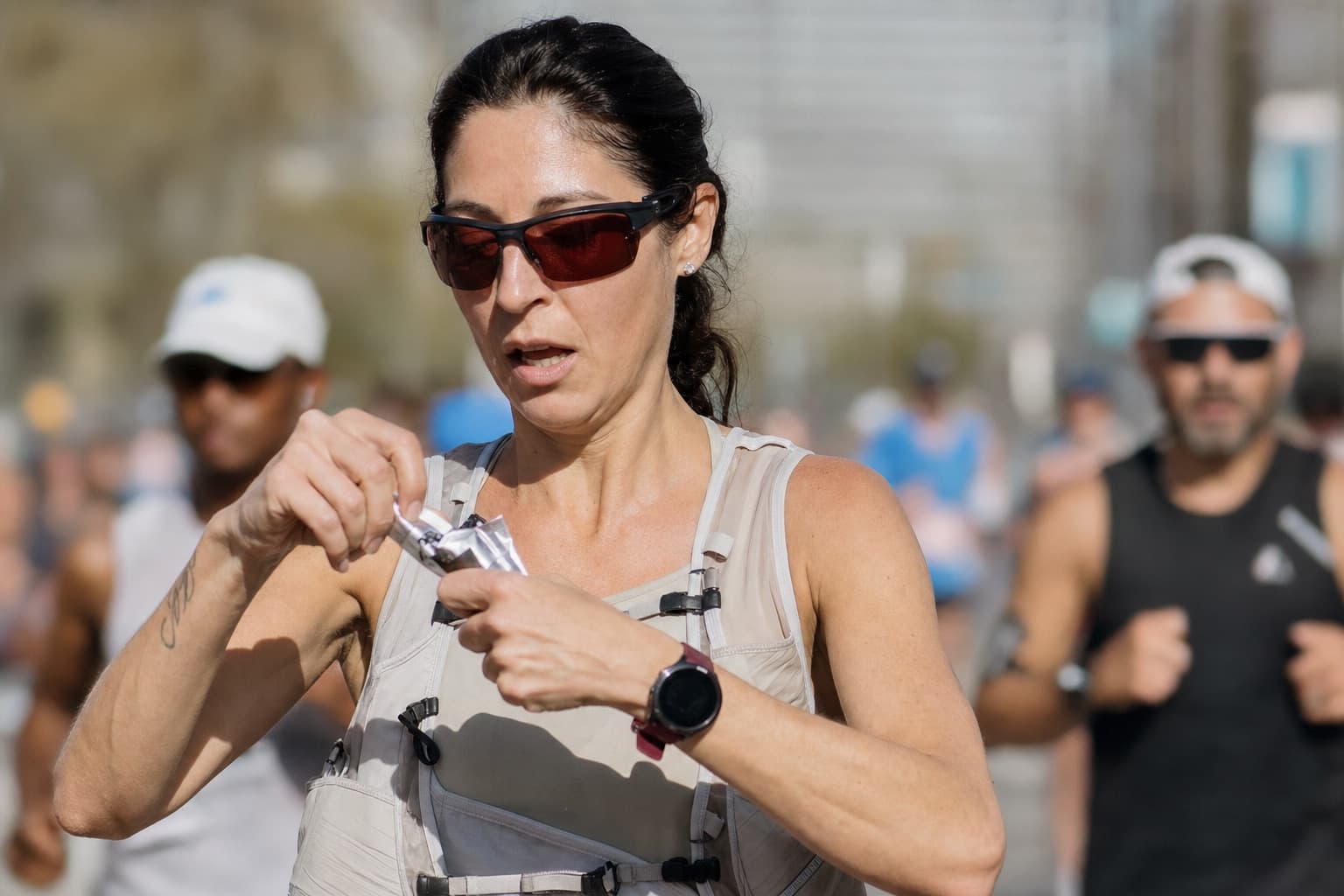
Why does skipping a fuel plan wreck first marathons?
Skipping a fuel plan wrecks first marathons. Your body cannot store enough fuel for 26.2 miles on its own. Sports nutrition research recommends 30 to 60 grams of carbs per hour. This applies to exercise longer than about 2 hours (Jeukendrup, 2014). A marathon, for most first-time finishers, lasts well past that mark.
Many first-time marathoners plan their training runs in detail. They never plan their race-day fuel the same way. That is backwards. Fuel is not something you figure out mid-race. Practice your fuel plan on long training runs. Use the exact pace and gel brand you plan to use on race day. Race day is not the place to learn that a gel upsets your stomach.
A simple starting plan works for most first-timers. Take a gel every 40 to 45 minutes, starting around 45 minutes into the race. Sip water or a sports drink at aid stations. Adjust the exact timing based on what feels right in training, not on race morning.
How does peaking too early hurt your first marathon?
Peaking too early hurts your first marathon because it leaves you tired on race day, not fresh. This happens two ways. Some runners skip their taper. They worry that resting will cost them fitness. Others build their biggest, hardest long run too close to race day. They never fully recover from it.
A meta-analysis of tapering research looked at this question. A roughly 2-week taper produced the biggest gains for endurance athletes. Training volume dropped by 41 to 60 percent. Intensity stayed the same the whole time (Bosquet et al., 2007). Skipping that taper means racing on legs that never got the chance to recover. Cutting it to a few days does the same thing.
The fix is to trust the taper. Cut your weekly mileage in the final 2 weeks before the race. Keep some short, faster efforts in the mix, so your legs stay sharp. Do not chase one more big long run in the final 10 days. That run will not add fitness. It will only add fatigue.
Trusting a taper is harder than it sounds. Lower mileage can feel like you are losing fitness you worked hard for. That feeling is misleading. The fitness is already banked. The taper's only job is to let your body absorb it.

Why does new gear ruin first marathons?
New gear ruins first marathons. Untested shoes and socks create friction your feet have never met before. Over 26.2 miles, that friction turns into blisters. A review of blister research found that friction blisters form from repeated shear stress on the skin. Moisture and unfamiliar footwear make that stress worse (Rushton & Richie, 2024). New shoes have different seams, different padding, and a different fit than shoes your feet already know.
The fix is old-fashioned but reliable. Race in shoes with at least 30 miles of training on them. That way, any weak spots have already shown up in a lower-stakes run. Wear the exact socks you plan to race in during your last few long runs. Never try a new shirt, a new pair of shorts, or a new brand of anything on race morning.
This rule applies beyond shoes and socks. New shorts can chafe. A new sports bra can rub. A new brand of gel can upset your stomach. If you have not tested it on a long run, do not test it on race day.
How should you actually pace your first marathon?
Pace your first marathon at or slightly below your goal pace for the first 10 km. Hold that pace as long as you can after that. This connects directly back to the biggest mistake on this list. A controlled start only works if your goal pace is realistic. A goal pulled from a hopeful guess sets you up to fade, even with careful pacing.
This is where a real target time matters. It matters more than any single piece of race-day advice. If your goal pace is wrong, even perfect pacing still ends in a fade. For a deeper walkthrough of split strategy, read how to pace a marathon.
How does PIRX help first-time marathoners avoid these mistakes?
A single fixed formula gives every runner the same goal time. It has no way to know if that number fits your training. PIRX is a proprietary machine-learning prediction engine. It learns from your own runs instead. It breaks your fitness into five drivers: Aerobic Base, Threshold Density, Speed Exposure, Load Consistency, and Running Economy. These drivers sum to your total improvement, in seconds. That tells you exactly where your fitness stands before race day.
From there, PIRX gives you a Projected Time with a Supported Range. Your first marathon goal comes from your actual training, not a formula that treats every runner the same. Strava tells you what you ran. Garmin shows your splits. PIRX explains what your training actually supports on race day. PIRX users see 98% validated prediction accuracy.
Fueling matters as much as pacing does. See how many gels for a marathon for the full plan. Also read carb loading before a marathon for race-week fueling.
Avoid the mistakes, not just the training gaps
Stop guessing your first marathon goal pace from a shorter race you ran months ago. Generic watch algorithms treat every runner the same. Your fade risk is personal to your own training. Connect your Garmin, COROS, or Strava to PIRX in under 30 seconds. See your five performance drivers. Find out where your seconds come from. Get a Projected Time built on your own training, not a one-size-fits-all calculator.
Get your own projection in seconds — free, no signup, no wearable.
Marathon Time PredictorSources
- Smyth, B. (2018). Fast starters and slow finishers: a large-scale data analysis of pacing at the beginning and end of the marathon for recreational runners. Journal of Sports Analytics. (1.7 million finishers studied. A 10% too-fast start added about 37 minutes on average.)
- Jeukendrup, A. (2014). A step towards personalized sports nutrition: carbohydrate intake during exercise. Sports Medicine. (ACSM guidelines suggest 30-60 g of carbohydrate per hour beyond roughly 2 hours of exercise.)
- Bosquet, L., Montpetit, J., Arvisais, D. & Mujika, I. (2007). Effects of tapering on performance: a meta-analysis. Medicine & Science in Sports & Exercise. (A 2-week taper, cutting volume by 41-60%, produced the largest gains.)
- Rushton, R. & Richie, D. (2024). Friction blisters of the feet: a critical assessment of current prevention strategies. Journal of Athletic Training. (Blisters form from repeated shear stress. Moisture and new footwear make it worse.)
Already know your number? Start your 14-day free trial