Half Marathon Fueling: Do You Even Need Gels?

On this page
Here is the short answer. Whether you need gels depends on your finish time. Under 1 hour 30 minutes, most runners do not need in-race fuel. Over 1 hour 30 minutes, adding 1 or more gels usually helps. The half marathon sits right at the edge where fueling starts to matter.
The table below breaks this down by finish time.
| Finish time | Carbs needed | Gels | Notes |
|---|---|---|---|
| Under 1:30 | 0 g | 0 gels | Pre-race meal covers this distance |
| 1:30-1:45 | 0-20 g | 0-1 gels | Optional, based on personal preference |
| 1:45-2:00 | 20-30 g | 1 gel | Take it near the halfway point |
| 2:00-2:15 | 30-50 g | 1-2 gels | Space gels 40-45 min apart |
| 2:15 and up | 50-75 g | 2 or more gels | Space gels every 35-40 min |
Get your own projection in seconds — free, no signup, no wearable.
Half Marathon Time PredictorDo you need gels for a half marathon?
It depends on your finish time. A half marathon is 13.1 miles. Runners finish it in just over 1 hour. Others take more than 3 hours. That is a huge range. Fast runners finish before fuel becomes an issue. Slower runners spend enough time running that fuel starts to matter.
- 90 min
- the point where in-race carbs start to matter for most runners
Research on distance events looked at this exact question. It found that within-race carbs become more useful once exercise passes about 90 minutes (Burke et al., 2019). Under that mark, your stored fuel is often enough on its own. Past that mark, added carbs help protect your pace late in the race.
What is the 90-minute rule?
The 90-minute rule is a simple guide, not a strict law. Your body stores enough carbs for roughly 60 to 90 minutes of hard running. After that, stored fuel starts to run low. Adding carbs from a gel or drink can help fill that gap.
This is why a 1:25 half marathoner often does fine with no gels at all. Their race ends before stored fuel becomes a real limit. A 2:15 half marathoner runs well past that 90-minute mark. For them, a gel or two helps protect the final miles from a fuel-related fade.
Even under 90 minutes, some runners still like a gel out of habit or comfort. There is little harm in this. Just make sure your stomach tolerates it. The rule is a guide for who benefits most. It is not a rule that bans gels for faster runners.
How many carbs do you need for a half marathon?
For runners racing over 90 minutes, aim for 30 to 60 grams of carbs per hour. This range matches guidance for exercise over an hour at a hard effort (Kerksick et al., 2017). It sits below the 60 to 90 gram range used for a full marathon. A half marathon is shorter, so it needs less fuel overall.
Most gels carry 20 to 30 grams of carbs each. One gel near the halfway point often covers a 1:45 to 2:00 finisher well. Two gels, spaced apart, suit a finisher over 2 hours. Match your gel count to your expected finish time from the table above. Then adjust based on how you feel that day.
Even a small amount of carbs can help before the 90-minute mark. Some studies found a benefit from as little as 20 grams of carbs an hour (Jeukendrup, 2014). A half gel can still help near the 90-minute line. A few sips of sports drink work too.
What if you are running an easy, social half marathon?
Fueling still matters, even at an easy pace. A slow, social half marathon can take 2.5 to 3 hours. That is plenty of time for stored fuel to run low. This happens even without a hard effort. Do not skip fuel just because the pace feels relaxed.
Use the same table above, based on your actual finish time, not your effort level. A 2:45 half marathon at an easy pace still benefits from 1 to 2 gels. Slower does not always mean less fuel is needed. Duration matters more than intensity for this decision.
Bring a small snack you enjoy if gels feel unpleasant at an easy pace. Dried fruit, chews, or a small sports drink all work. The goal is simply getting enough carbs in over a long time on your feet.
Should you fuel differently in hot weather?
Heat can shrink your appetite for gels, even in a half marathon. Blood shifts toward your skin to help cool you down. This can slow digestion. Sweet, thick gels get harder to stomach. Many runners feel this most in the later miles, once body temperature has climbed.
On hot days, try smaller, more frequent doses instead of one full gel at a time. A half gel with a sip of water can sit better than a full gel with nothing. Test this pairing in training before race day, especially if your race falls in summer heat.
Fluid matters alongside fuel in hot conditions. A half marathon usually needs less total fluid than a marathon. This is simply due to less time on the course. Still, do not ignore thirst just because the race is shorter. Drink to thirst, as you would for any distance.

How should fast half marathoners think about fueling?
Fast half marathoners, those finishing under 1:30, can usually skip in-race gels. Their race ends before stored fuel becomes a limit for most runners. A solid pre-race meal is often enough on its own. See our guide on what to eat before a race for that plan.
Some elite and sub-elite runners still take a small amount of fuel. This is often just for the mental boost of a routine. It is a personal choice, not a physical need, at this speed. If gels upset your stomach at race pace, skip them. That is a reasonable, low-risk choice for a fast finisher.
What happens if you skip fueling altogether?
Skipping fuel in a fast half marathon rarely causes a problem. Your stored fuel likely covers the whole distance. You may finish feeling fine without any gel at all.
Skipping fuel in a slower half marathon carries more risk. You may feel your pace fade in the final 3 to 4 miles. Runners often call this hitting the wall. A half marathon wall feels milder than a marathon one. Legs feel heavy. Focus gets harder to hold. A small amount of carbs can prevent much of this.
Not sure which group fits you? Check your projected finish time first. A projection near 1:30 leans toward skipping fuel. A projection near 2:00 or slower leans toward taking at least 1 gel. When in doubt, carry a spare gel. An unused gel costs you nothing.
Should you use a sports drink instead of gels?
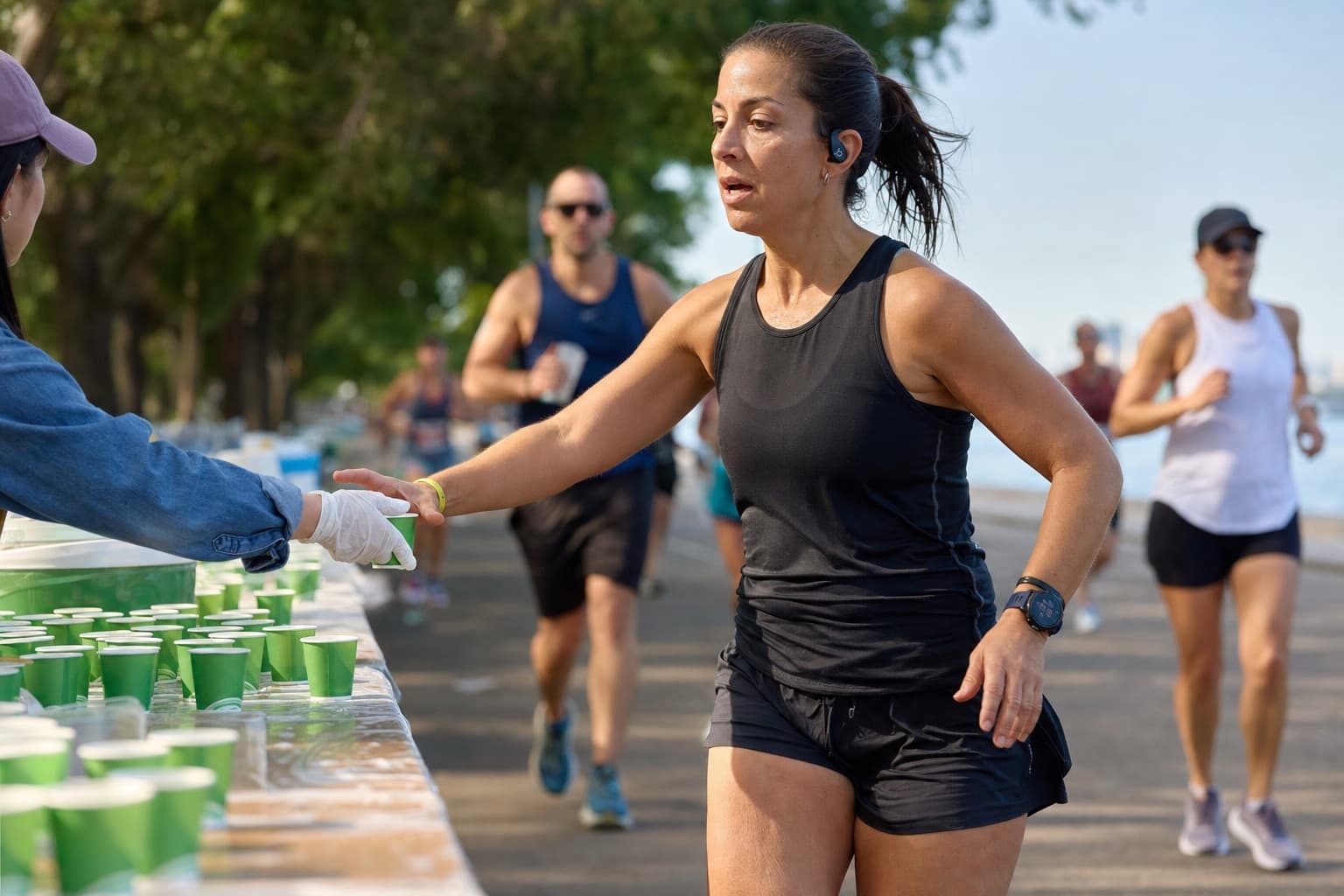
Yes, a sports drink can replace gels for many runners. Sports drinks carry carbs and fluid together in one cup. This can simplify your race. You get 2 needs met with 1 stop at an aid station.
Check the sports drink offered at your race in advance. Race websites often list the brand ahead of time. If you know it upsets your stomach, bring your own gels instead and skip that table.
Some runners like to mix both. They drink at aid stations for fluid. They carry 1 gel for a mid-race boost. This split works well for many half marathon finishers. It suits the 1:45 to 2:15 range especially well. A light plan already covers most of their needs.
Why finish time, not guesswork, should set your fueling plan
Every number in this guide starts from your finish time. Guess your finish time wrong, and your fueling plan shifts out of place. A rule built for a 2:15 finisher does not fit a 1:40 finisher. The reverse is also true.
PIRX is a proprietary machine-learning prediction engine. It learns from your own training data. It does not use one formula for everyone. It breaks your fitness into 5 drivers. These are Aerobic Base, Threshold Density, Speed Exposure, Load Consistency, and Running Economy. They sum to your total improvement, in seconds. PIRX then gives you a Projected Time with a Supported Range. Your fueling plan can start from a real number, not a guess.
"Fueling by finish time only works if the finish time is accurate." That is the core idea behind this whole guide. PIRX reaches 98% validated prediction accuracy (PIRX users). That lets you plan your gels around a projection you can actually trust.
Once your half marathon plan is set, check your pacing too. Read how to pace a marathon for pacing lessons that carry over to any distance. Stepping up in distance later? See how many gels for a marathon. Also check carb loading before a marathon to prepare.
Stop guessing what your training is worth. Don't rely on generic watch algorithms that treat every runner the same. Connect your Garmin, COROS, or Strava to PIRX in under 30 seconds. See your 5 performance drivers, and get your race-time projection. Then build your half marathon fueling plan around a number you can trust.
Get your own projection in seconds — free, no signup, no wearable.
Half Marathon Time PredictorSources
- Burke, L.M., Jeukendrup, A.E., Jones, A.M. & Mooses, M., in International Association of Athletics Federations (2019). Consensus Statement 2019: Nutrition for Athletics. International Journal of Sport Nutrition and Exercise Metabolism. (Within-race carbohydrate becomes more important for events lasting over 90 minutes.)
- Kerksick, C.M. et al. (2017). International Society of Sports Nutrition position stand: nutrient timing. Journal of the International Society of Sports Nutrition. (30-60 g/h of carbohydrate recommended for exercise bouts over 60 minutes at high intensity.)
- Jeukendrup, A.E. (2014). A step towards personalized sports nutrition: carbohydrate intake during exercise. Sports Medicine. (Small amounts of carbohydrate, around 20 g/h, can provide a performance benefit even at shorter durations.)
Already know your number? Start your 14-day free trial