Marathon Hydration Strategy: How Much to Drink

On this page
Here is the short answer. Drink to thirst, not to a fixed schedule. Most runners need 400 to 1200 milliliters of fluid an hour, based on sweat rate and weather. Add sodium if you sweat heavily or race in the heat. Never force fluid past what feels comfortable, since overdrinking is more dangerous than mild dehydration in a marathon.
The table below shows a starting range by conditions.
| Conditions | Sweat rate | Fluid target (mL/hr) | Sodium note |
|---|---|---|---|
| Cool, under 15C (59F) | Low | 400-500 mL | Often optional |
| Mild, 15-21C (59-70F) | Moderate | 500-700 mL | 300-500 mg/hr |
| Warm, 21-27C (70-80F) | High | 700-950 mL | 500-700 mg/hr |
| Hot or humid, over 27C (80F) | Very high | 950-1200 mL | 700-900 mg/hr |
Get your own projection in seconds — free, no signup, no wearable.
Marathon Time PredictorHow much should you drink during a marathon?
Most runners need 400 to 1200 milliliters of fluid per hour. That is about 2 to 5 cups. This wide range comes from sports medicine guidance on fluid during exercise (Sawka et al., 2007). Your own number depends on three things. These are your sweat rate, your body size, and the weather that day.
- 400-1200 mL/hr
- fluid range supported for marathon runners, based on sweat rate and heat
A cool, dry day calls for the low end. A hot, humid day pushes you toward the high end. Heavy sweaters need more fluid than light sweaters. This is true even at the same pace and heat. There is no single correct number for every runner.
Should you drink to a schedule or to thirst?
Drink to thirst. This is the safer choice for almost every runner. Doctors have studied marathon runners who drank on a fixed schedule. This habit links to a real medical risk. The risk is a dangerous drop in blood sodium, called hyponatremia (Hew-Butler et al., 2017).
For years, runners were told to drink as much as possible. That old advice has changed. Drinking too much, not too little, is now seen as the bigger risk in most marathon cases (Hew-Butler et al., 2017). Your own thirst is a better guide than a fixed schedule.
A fixed schedule still has one use. Treat it as a rough upper limit, not a strict target. Use the table above as a ceiling. Let your thirst decide where you land inside that range on any given day.
Do you need electrolytes during a marathon?
Electrolytes are minerals lost through sweat. Sodium is the main one that matters for runners. Many runners benefit from some sodium, especially in a marathon over 2 hours. Sports medicine guidance suggests about 0.5 to 0.7 grams of sodium per liter of fluid (Sawka et al., 2007). This works out to roughly 300 to 900 milligrams of sodium per hour. The exact amount depends on how much fluid you drink.
Sodium leaves your body through sweat. Heavy, salty sweaters lose more than light sweaters do. You may be a salty sweater if you see white marks on dark clothing after a long run. These runners often need the most added sodium during a marathon.
Sodium is not required for every runner, though. Shorter efforts need less. Cool weather needs less. Light sweat rates need less too. If your marathon runs under 2 hours and the weather is mild, plain water may be enough for you.
What is hyponatremia, and why does it matter?
Hyponatremia means low blood sodium. It is a medical term worth knowing. Doctors define it as a blood sodium level under 135 units per liter (Hew-Butler et al., 2017). It can happen when a runner drinks far more fluid than their body loses through sweat.
This condition is serious. In rare cases, it has caused death in marathon runners. Most cases come from drinking too much plain water for hours. They are not caused by a lack of sodium alone. Weight gain during a race is often a warning sign. It shows more fluid coming in than going out.
The fix is simple. It is already covered above. Drink to thirst. Do not force extra cups at every aid station just because they are there. If you finish a marathon heavier than you started, you likely drank too much.
How does hot weather change your hydration plan?
Heat raises your sweat rate. Your fluid need goes up too. Move toward the higher end of the table on hot or humid race days. Your body works harder to cool itself. That process uses more fluid and more sodium than a cool day does.
Humidity matters as much as heat. Sweat cools you as it dries on your skin. Humid air slows that drying down. This means you can overheat fast. It can happen even on a day that does not feel very hot.
Practice your hot-weather hydration plan in training first. Do not guess at a higher fluid and sodium target for the first time on race morning. Test it on a warm long run instead, so your gut already knows what to expect.
How do you find your own sweat rate?
Weigh yourself before and after a one-hour run, without drinking during that hour. Each pound lost roughly equals two cups of sweat. Each kilogram lost roughly equals one liter of sweat. This simple test gives you a rough hourly sweat rate to work from.
Repeat this test in different weather. Your sweat rate on a cool spring morning will differ from a hot summer afternoon. Testing a few times across the season builds a clearer picture of your personal range. Write each result down so you can compare them later.
Use this number as a starting point, not a strict rule. Match your race-day fluid intake to roughly what you lose. Then adjust based on thirst as the race goes on. This keeps you close to replacing losses. It also avoids forcing extra fluid your body does not need.
What should you drink besides water?
Plain water is fine for shorter, cooler races. Longer or hotter races usually call for something more. Sports drinks carry both carbs and sodium in one cup. This can cover two needs at once, fuel and fluid.
Check the label on your sports drink. Some carry more sodium than others. Some carry more sugar than others too. Test a few brands in training to find one your stomach handles well.
Plain water alone, for hours, can water down your blood sodium. This is one reason sports drinks or salt tablets matter on a long, hot race day. A mix of water and a sodium source often works better than water on its own.
How do aid stations fit into your plan?
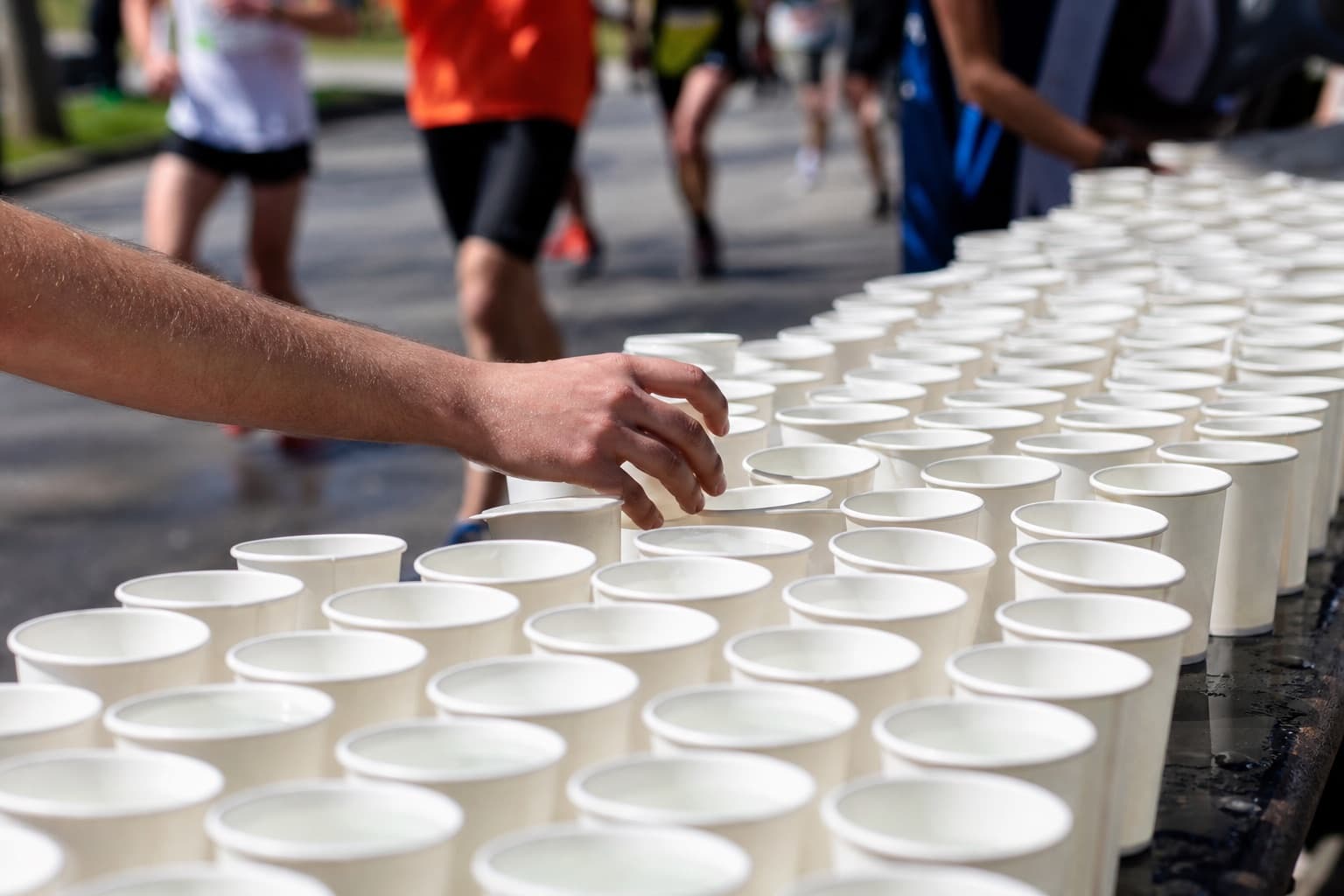
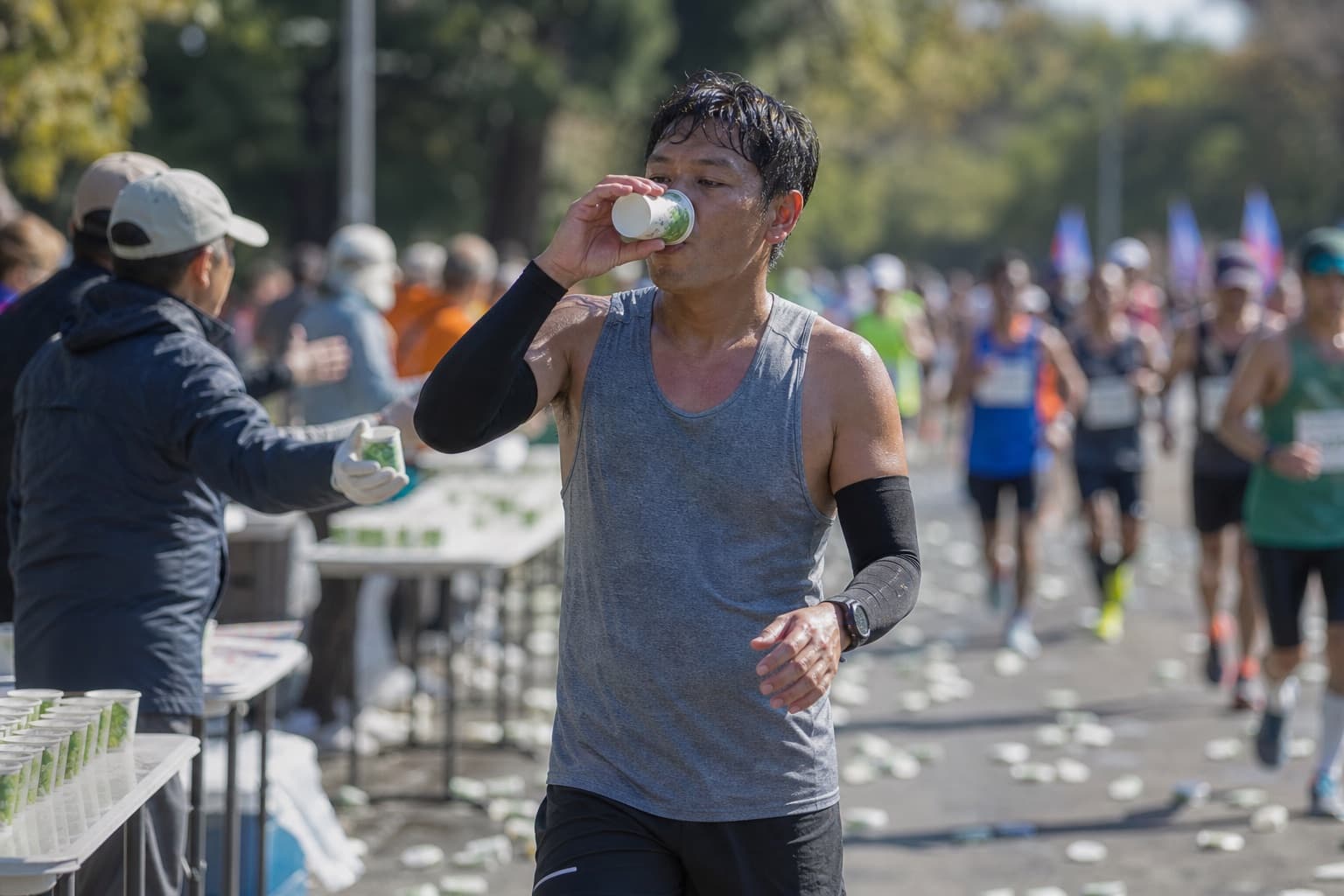
Aid stations offer a chance to drink, but they set the pace too fast for some runners. Do not feel forced to drink at every single stop. Use your own thirst and your planned target as the guide instead.
Grabbing a cup can be tricky at speed. Slow down slightly, or walk for a few steps, if that helps you drink safely. A spilled cup gives you less fluid than planned. A careful sip beats a rushed gulp that ends up on your shirt.
Some races space aid stations unevenly. Check the course map before race day. If a long gap sits ahead, carry a small handheld bottle or a soft flask to cover it. This avoids a long stretch with no fluid option at all.
Why a fixed hydration number cannot know your race
A single mL-per-hour target treats every runner the same. It cannot see your training history. It cannot see your real finish time either. Pacing wrong changes your effort level. Effort level then changes your sweat rate too.
PIRX is a proprietary machine-learning prediction engine. It learns from your own training data. It does not use one formula for everyone. It breaks your fitness into 5 drivers. These are Aerobic Base, Threshold Density, Speed Exposure, Load Consistency, and Running Economy. They sum to your total improvement, in seconds. PIRX then gives you a Projected Time with a Supported Range. You can pace, and fuel, around a real target.
"Hydration only works if your pacing plan is realistic." A finish time that is too fast can lead to trouble. You may overheat. You may rush your fluid intake late in the race. PIRX reaches 98% validated prediction accuracy (PIRX users). That gives your hydration plan a pace target that actually holds up.
Pair your hydration plan with the rest of race week. See how many gels for a marathon for your carb plan. Read how to pace a marathon to avoid a hot, rushed start. Check carb loading before a marathon too. Stored fuel affects how your body handles fluid.
Stop guessing what your training is worth. Don't rely on generic watch algorithms that treat every runner the same. Connect your Garmin, COROS, or Strava to PIRX in under 30 seconds. See your 5 performance drivers, and get your race-time projection. Then build your hydration plan around a pace you can trust.
Get your own projection in seconds — free, no signup, no wearable.
Marathon Time PredictorSources
- Sawka, M.N. et al., American College of Sports Medicine (2007). Position stand: exercise and fluid replacement. Medicine & Science in Sports & Exercise. (600-1200 mL/hr fluid intake and 0.5-0.7 g sodium per liter for exercise over 1 hour.)
- Hew-Butler, T., Loi, V., Pani, A. & Rosner, M.H. (2017). Exercise-associated hyponatremia: 2017 update. Frontiers in Medicine. (Overdrinking beyond thirst is the leading cause of exercise-associated hyponatremia; drink-to-thirst prevents most cases.)
Already know your number? Start your 14-day free trial