Current Honest State (Analysis)
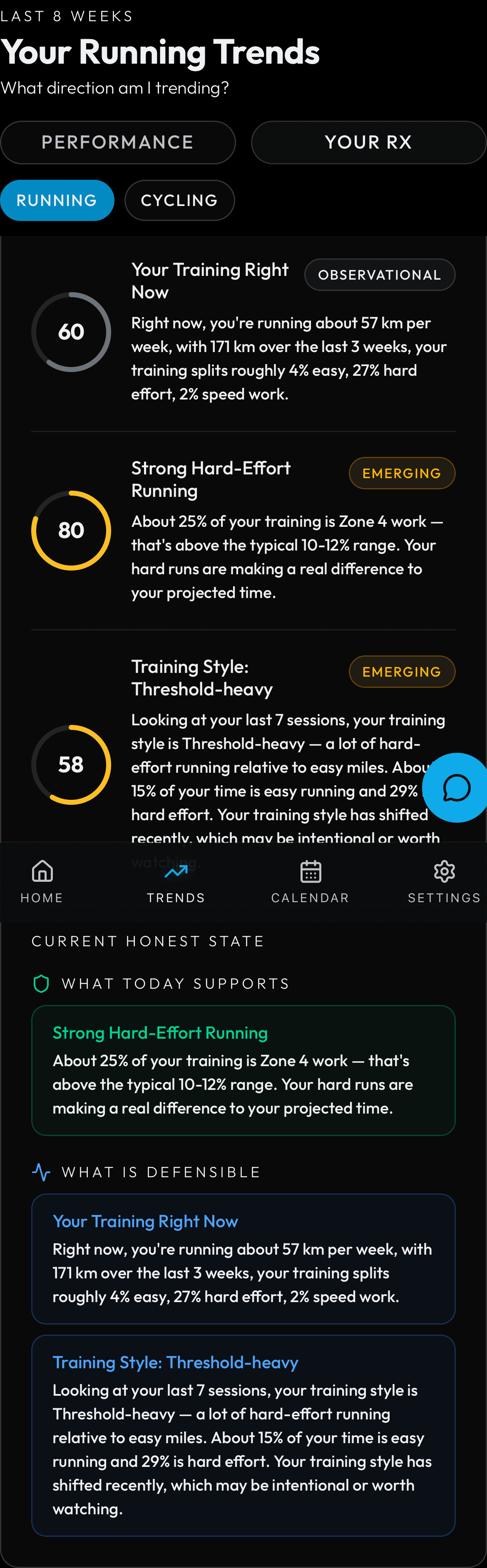
Source: (inline in performance/page.tsx)
What You See
Three color-coded sections: 'What Today Supports' (green -- your strengths), 'What Is Defensible' (blue -- things that are solid), and 'What Needs Development' (amber -- areas to work on). Each section has titled cards with detailed explanations.
How the Numbers Work
PIRX looks at your driver scores, training patterns, and physiological data to sort your fitness into three honest buckets. It does not sugarcoat things -- the goal is to give you a truthful picture of where you stand today.
Step by Step
Models & algorithms used: LearningModule pattern detectors (KMeans, Pearson/Spearman correlation, ACWR thresholds)
The backend runs every LearningModule detector on your oldest-first feature history and each insight is tagged with a semantic polarity when it is generated. 'What Today Supports' (green) collects every insight with polarity strength — things the data affirms are working for you (steady training, strong hard-effort running, good speed work, positive feature-to-driver correlations, "more miles are paying off"). 'What Is Defensible' (blue) collects neutral insights — descriptive context like 'Your Training Right Now' and 'Training Style: Polarized' that are true but not inherently good or bad. 'What Needs Development' (amber) collects risk insights — high ACWR warnings, low Zone 4 exposure, declining volume, increasing inconsistency, the personal training-limit flag, and negative feature-to-driver correlations. Confidence (observational / emerging / supported) is preserved on each insight for the Learning tab rings but does NOT affect which honest-state bucket an insight lands in — polarity and confidence are independent signals.