Race-Anchored Projection
When PIRX shows a "Race-anchored" badge, your Projected Time is pinned to a real race you ran. Here is what that means and how the accuracy safeguards work.
When you see the green "Race-anchored" badge on your Projection Tile, it means your Projected Time is pinned to a real race you ran — not just estimated from training. A real race is the strongest evidence of what you can run, so PIRX treats it as the truth and builds around it.
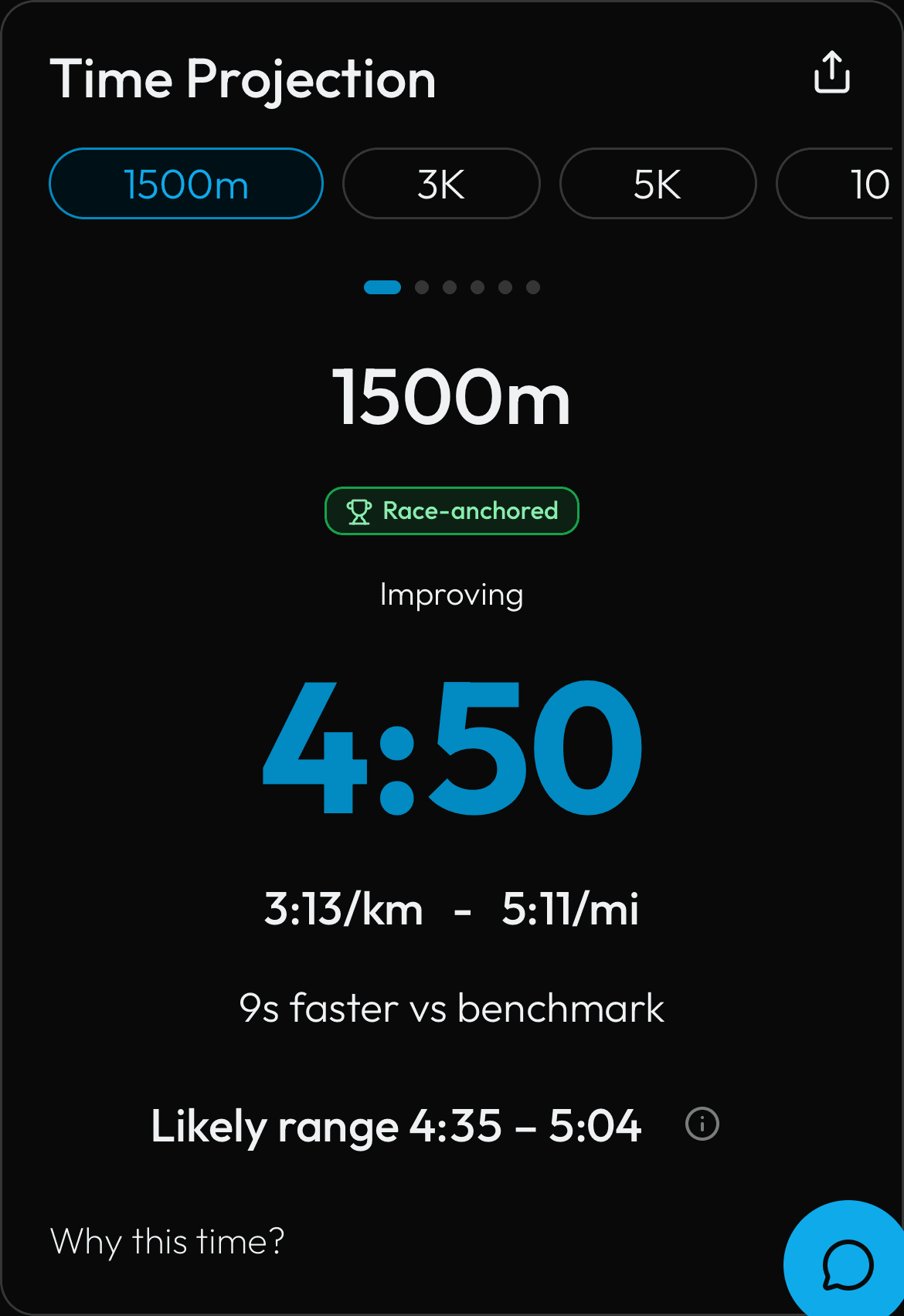
What "Race-anchored" means
PIRX constantly compares your projection against your actual race results. Two rules keep the number honest:
- Your projection can never be much faster than your best race. If PIRX projects a time more than about 3 percent faster than a race you actually ran at that distance, the projection is pulled back to just inside that race time. A prediction should not outrun your proof.
- Your projection can never be slower than a recent race. If you raced faster in the last 60 days than PIRX is projecting, the projection is pulled forward to match. You already proved you can run that time.
When either rule fires, the badge appears so you know the number is grounded in a real result.
Which races count
| Race evidence | How PIRX uses it |
|---|---|
| A race recorded by your watch | Anchors the projection at that distance automatically |
| A race you entered manually (no watch data) | Treated exactly like a recorded race |
| A race at a different distance | Converted to your target distance with a power-law formula before anchoring |
| A "race" run at easy effort | Ignored — see safeguards below |
The accuracy safeguards
Not every activity tagged "race" is a real race, and not every fast training segment means a new fitness level. PIRX runs a set of safeguards on every recalculation:
- Heart-rate check. An activity tagged as a race only counts as race evidence if your heart rate shows real effort (roughly 75 percent of your max or higher). A jog tagged "race" will not drag your projection down. A genuinely hard race (85 percent of max or higher) is trusted at any distance.
- Training cannot beat a recent race by much. A fast interval session or a GPS-inflated segment can look faster than you really are. If you raced within the last 60 days, training evidence can only move your baseline up to 10 percent faster than that race. Older races allow up to 25 percent.
- Sparse-data check. When PIRX has only a couple of race results to fit a model to, it will not extrapolate aggressively. It needs enough data points, spread across enough distance, before a fitted model can override direct evidence.
- Freshness heartbeat. Even when your projection has not changed, PIRX refreshes its timestamp at least every 14 days so you can always see the number is current — a stable projection is a result, not a stale one.
- Weekly accuracy audit. Every week, PIRX compares its past projections to races that actually happened. If an event's predictions are off by more than 8 percent, it is flagged and reviewed. This self-grading loop is how the model improves over time.
Why your projection sometimes jumps after a race
Right after you finish a race, PIRX re-anchors everything to that result. If the race was faster than your projection, your Projected Time improves immediately. If it was slower — and your heart rate shows it was a real effort — your projection comes down to match reality. Either way, the next number you see is built on what you just proved.
Related pages
Performance Trends
The Performance Trends page lets you dig deeper into your data across two tabs: Performance (zones, lactate threshold, running economy) and Your RX (what PIRX is learning about you).
Triathlon Projection
How PIRX projects your triathlon finish time — swim, bike, run, and transitions combined into one number, with a range that reflects each leg's data quality.